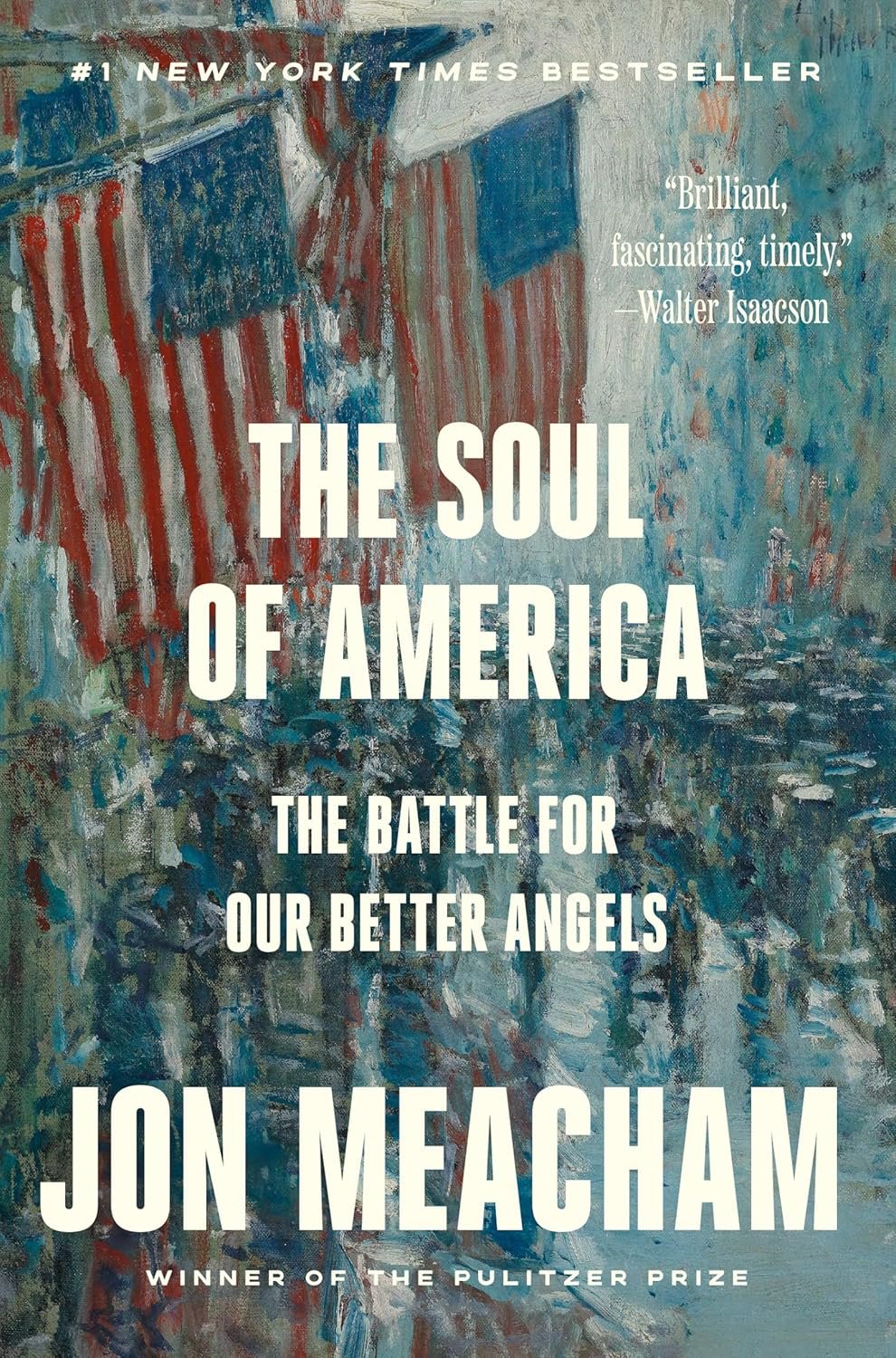
A few weeks ago, I finished listening to Jon Meacham’s The Soul of America: The Battle for Our Better Angels. To be candid, during the opening chapters, I wasn’t entirely certain if this title would earn a permanent spot on my recommended list. However, as the narrative progressed, the depth of the historical data took over. I found myself learning new details about our past and, equally important, being reminded of critical turning points that we too easily forget.
Understanding history isn’t about looking for a comfortable narrative; it is about examining the full ledger—our profound failures alongside our triumphs—and applying that knowledge to the present.
Book Recommendation & Review
Featured Recommendation: The Soul of America: The Battle for Our Better Angels
By Jon Meacham
Genre: History, Non-Fiction, Political Science
Audio Length: 10 hours, 55 minutes
Narrated by: Fred Sanders
The National Balance Sheet: A Look at Jon Meacham’s The Soul of America
A few weeks ago, I finished listening to Jon Meacham’s The Soul of America: The Battle for Our Better Angels. To be candid, during the opening chapters, I wasn’t entirely certain if this title would earn a permanent spot on my recommended list. However, as the narrative progressed, the depth of the historical data took over. I found myself learning new details about our past and, equally important, being reminded of critical turning points that we too easily forget.
Understanding history isn’t about looking for a comfortable narrative; it is about examining the full ledger—our profound failures alongside our triumphs—and applying that knowledge to the present.
The Technical Specs: Accuracy and Framework
Meacham treats history less like a seamless story and more like a series of critical stress tests. The book focuses on specific historical flashpoints where the country faced existential moral and political division: the Civil War and Reconstruction, the Jim Crow era, the anti-immigrant crusades of the 1920s, the Red Scare of McCarthyism, and the Civil Rights movement.
- Accuracy Level: High. Meacham is a Pulitzer Prize-winning biographer, and his reliance on primary source material—letters, presidential diaries, public speeches, and contemporary newspaper accounts—is meticulous. The historical data presented is robust and well-vetted.
- The Methodology: The strength of the book lies in its use of historical context as a mirror. By laid-out data points from past crises, Meacham demonstrates that intense partisan rancor, fear-mongering, and social fragmentation are not unique to our modern era; they are recurring features of the American landscape.
Navigating the Author’s Lens (Bias)
Every historian chooses which data points to highlight, and it is important to look at Meacham’s lens objectively.
Meacham writes from a viewpoint of institutional optimism. His bias is not strictly partisan-political, but rather philosophical. He operates from an inherent belief in the resilience of American democracy and the ultimate power of moral leadership (exemplified by figures like Abraham Lincoln, Theodore Roosevelt, and Lyndon B. Johnson).
For a reader who prefers a completely detached, clinical analysis of history, Meacham’s tone can occasionally lean toward the idealistic. However, because he does not shy away from documenting the ugly realities of our past—including executive overreach and systemic exclusions—the data remains credible even if you do not entirely share his optimistic outlook.
📊 Historical Flashpoints Explored
| Era | The Crisis / “Negative Side” | The Pivot / “Positive Side” |
| The 1860s | Civil War and the collapse of union. | Lincoln’s appeal to the “better angels of our nature.” |
| The 1920s | Resurgence of the KKK and intense nativism. | Legal and journalistic exposure of systemic corruption. |
| The 1950s | McCarthyism and weaponized political fear. | The bipartisan consensus that restored constitutional balance. |
Why Consider This Book?
The Soul of America is an invitation to look at the country’s history through a wider lens. It reminds us that progress is never linear or guaranteed; it is the result of deliberate choices made by citizens who understood the mechanics of their government and the values of their constitution.
If you are looking for an intellectual anchor that provides historical distance from the daily noise, this book offers a valuable perspective. It doesn’t offer easy answers, but it supplies the historical context necessary to ask better questions.
Audio Note: Narrated by Fred Sanders, with introductions and conclusions read by Meacham himself, the presentation is steady, articulate, and well-paced for reflective listening during a quiet afternoon or a long drive.