July14, 2026
Every energy source in this series has involved burning something, splitting something, or capturing something that already exists — oil, sunlight, heat from the earth, hydrogen separated from water. Fusion is different in kind, not just degree. It asks whether we can replicate on Earth the process that powers the sun itself: forcing light atomic nuclei together until they merge, releasing the energy that holds them apart.
The physics works. The sun proves that every day. The question is whether we can make it work here, at the scale and reliability a power grid requires, within a timeframe that matters for the energy transition.
The honest answer, as of July 2026, is: we are closer than we have ever been, and further than the headlines often suggest.
How Fusion Works — and Why It Is Hard
Fission, the process behind existing nuclear power plants, splits heavy atoms apart. Fusion does the opposite — it forces light atoms together. The fuel is hydrogen, specifically two heavy forms of it called deuterium and tritium. When they fuse, they form helium and release a fast-moving neutron carrying enormous kinetic energy. That energy, captured as heat, drives a turbine and generates electricity — in theory.
The challenge is confinement. For fusion to happen, the hydrogen fuel must be heated to temperatures exceeding 100 million degrees Celsius — roughly six to ten times hotter than the core of the sun. At those temperatures, matter exists as plasma, a superheated gas of charged particles that cannot touch any physical container without instantly cooling below fusion conditions. Every approach to fusion is essentially a different answer to the same engineering question: how do you hold something hotter than the sun?
Two Main Approaches — and What They Have Achieved
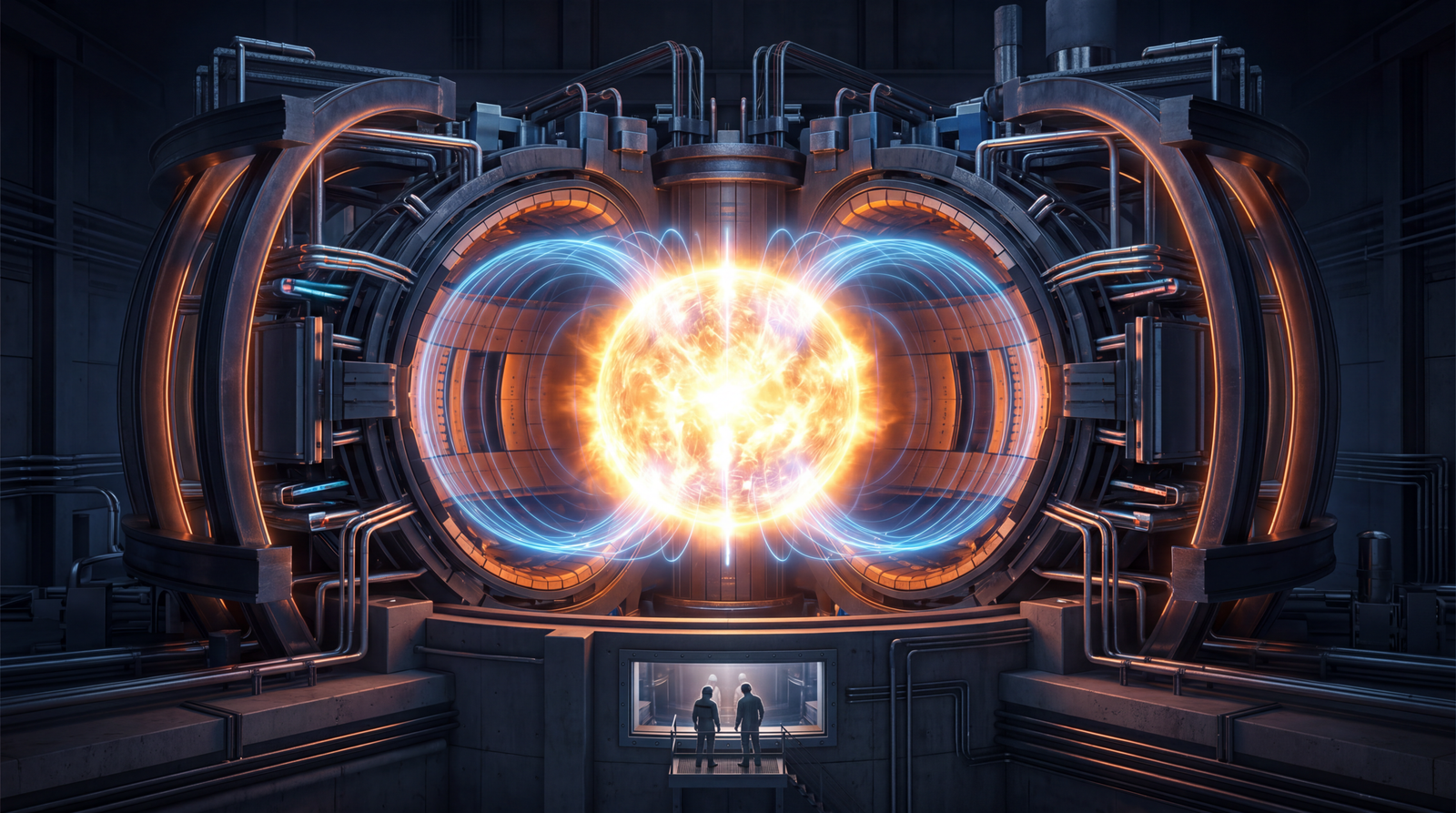
The dominant approach is magnetic confinement. Powerful magnetic fields create an invisible bottle that suspends the plasma without physical contact. The most common machine design is called a tokamak — a doughnut-shaped chamber where magnetic fields spiral around the plasma to keep it stable. A related design called a stellarator uses a more complex, twisted magnetic geometry that can, in theory, sustain plasma continuously without the disruptions tokamaks sometimes experience.
Both have produced real milestones recently.
In February 2025, France’s WEST tokamak maintained a stable plasma for 1,337 seconds — 22 minutes and 17 seconds — at 50 million degrees Celsius. That is a record for plasma duration in a tokamak and a meaningful proof of the kind of sustained operation a power plant would require.
Germany’s Wendelstein 7-X stellarator set its own record in May 2025, achieving 1.8 gigajoules of energy turnover over a six-minute plasma pulse — setting a new stellarator performance record through an exceptionally high triple product, which measures the combination of plasma density, temperature, and confinement time that determines whether a fusion reaction can sustain itself.
The second main approach is inertial confinement. Rather than using magnetic fields to hold plasma, this method compresses a tiny pellet of frozen deuterium-tritium fuel so rapidly — using powerful lasers — that the fuel’s own inertia holds it together long enough for fusion to occur, in a process that lasts nanoseconds.
The National Ignition Facility in Livermore, California, has made the most significant inertial confinement progress. In December 2022, NIF achieved scientific breakeven for the first time in history — producing more fusion energy from the fuel pellet than the laser energy delivered to it. Since then, the NIF team has repeated and improved that achievement eight times. The most recent record, set on April 7, 2025, produced 8.6 megajoules of fusion energy from a 2.08 megajoule laser pulse — a target gain greater than four.
The Most Important Clarification in All of Fusion
Here is where the essay must be precise, because this distinction is where nearly all fusion headlines mislead their readers.
The NIF’s “net energy gain” is measured at the target — the fuel pellet. The lasers that fired that 2.08 megajoule pulse at the target drew approximately 300 megajoules from the electrical grid to operate. The ratio of fusion energy produced to total electrical energy consumed by the facility is still far less than one. Scientific breakeven at the target is a genuine and important milestone. It is not the same as the engineering breakeven a power plant needs — where total electricity output exceeds total electricity input across the entire system.
The gap between those two things is not a small engineering refinement. It is one of the central challenges that separates the physics that has been proven from the commercial power plant that has not yet been built.
The Private Sector Bets
Despite that gap, the private sector has made a striking collective judgment that fusion is worth betting on now. Total private investment in fusion technology reached approximately $10 billion by mid-2025, according to the Fusion Industry Association — a five-fold increase since 2021. In the twelve months ending July 2025, the sector added $2.64 billion, the strongest fundraising period since 2022. Investment has continued, with Helion alone raising $465 million in June 2026 — though comprehensive industry totals for the most recent twelve months are not yet available.
Two companies represent the poles of the private fusion landscape.
Commonwealth Fusion Systems, a Massachusetts Institute of Technology spinout, is building a demonstration machine called SPARC in Massachusetts using a new generation of high-temperature superconducting magnets that generate stronger magnetic fields in a much smaller footprint than previous designs. A series of peer-reviewed scientific papers published this year have validated the underlying physics of their approach. If SPARC demonstrates net energy gain on schedule, the company plans to begin construction of a 400-megawatt commercial plant in Virginia in the early 2030s under an agreement with Google.
Helion Energy is taking a different approach — and a more aggressive timeline. In June 2026, Helion raised $465 million in a new funding round valuing the company at $15.5 billion, bringing total funding to over $1.5 billion. The company broke ground in July 2025 on Orion, its first commercial fusion plant, in Malaga, Washington — under what it describes as the world’s first fusion power purchase agreement, committing to deliver at least 50 megawatts of electricity to Microsoft data centers by 2028.
It is worth being specific about what Helion has and has not demonstrated. Its seventh-generation prototype, Polaris, became the first privately funded fusion machine to operate with deuterium-tritium fuel and reach plasma temperatures exceeding 150 million degrees Celsius. Those are real technical milestones. Polaris has not yet demonstrated net electricity production from fusion. Whether Orion can scale from those prototype results to a commercial power plant by 2028 is a timeline that most independent fusion scientists consider extraordinarily ambitious.
The Unresolved Bottlenecks
Even setting aside timelines, three fundamental engineering challenges stand between today’s fusion physics and a working power plant.
The first is fuel. The easiest fusion reaction uses tritium — a radioactive form of hydrogen that does not exist in nature in meaningful quantities. The entire global supply is produced as a byproduct of a small number of heavy-water fission reactors. Every fusion power plant design requires a mechanism called a lithium breeder blanket, in which neutrons from the fusion reaction strike lithium lining the reactor walls and produce tritium fuel in a closed loop. This mechanism has never been integrated or demonstrated at the scale a working reactor requires.
The second is materials. The neutrons released by deuterium-tritium fusion carry extremely high energy — enough to physically displace atoms inside the steel and alloy walls of the reactor over time. This makes the structural material brittle, radioactive, and increasingly compromised with use. Developing materials that can withstand years of this neutron bombardment without failing is one of the most active and difficult areas of fusion materials science. There is currently no dedicated facility capable of testing materials under the exact neutron environment a commercial fusion reactor would produce.
The third is heat exhaust. The inner walls and divertor plates of a magnetic confinement reactor must absorb and remove enormous heat fluxes — conditions that rival a spacecraft re-entering Earth’s atmosphere, concentrated on small surface areas. Managing that heat without melting or degrading critical components over long operating periods remains an unsolved engineering problem at commercial scale.
State of Play, as of July 2026
This is a field moving fast enough that specific figures will date within months. As of this writing: the National Ignition Facility has achieved scientific breakeven eight times and is pursuing an upgrade from 2.2 to 2.6 megajoules of laser energy, which could enable fusion yields exceeding 30 megajoules. Commonwealth Fusion Systems’ SPARC demonstration machine is targeting a net energy gain demonstration by late 2026. Helion’s Orion plant is under construction in Washington state. The U.S. Department of Energy’s Fusion Science and Technology Roadmap is targeting a commercial pilot plant by the mid-2030s. ITER, the massive international tokamak being built in France as the largest fusion experiment ever attempted, remains under construction with first plasma now expected in the late 2020s.
Private fusion companies have raised nearly $10 billion in total. The U.S. accounts for over 75 percent of that capital. At least two companies — Helion and Commonwealth Fusion Systems — have signed power purchase agreements with major technology companies, creating commercial deadlines that are driving development timelines in ways academic fusion research never did.
What This Means
Fusion is real physics. The sun has been demonstrating that for five billion years. What remains unproven is the engineering path from a controlled laboratory plasma to a reliable commercial power plant — the tritium supply chain, the materials that can survive years of neutron bombardment, the heat exhaust systems, the wall-plug efficiency that makes the whole system energy-positive at scale.
The private sector is betting that those problems are solvable within this decade. The scientific community is more measured, pointing to mid-2030s for a pilot plant as a realistic best case. Both may be right about different pieces of the problem — the private firms may accelerate the engineering while the physics institutions provide the rigorous measurement of whether it actually works.
What is clear is that fusion has crossed a threshold in the past three years that it had not crossed in the previous sixty. Scientific breakeven has been achieved and repeated. Private capital is funding engineering at a scale and urgency that government programs alone never did. The timeline is still uncertain. The direction is not.
This series began with a crisis in a narrow waterway and has traveled through oil reserves, battery minerals, nuclear reactors, geothermal wells, hydrogen fuel cells, and now the interior of a plasma burning hotter than the sun. The final essay steps back from individual technologies to ask the larger question the whole series has been building toward: what will it actually take — in policy, investment, and time — for the energy transition to succeed?