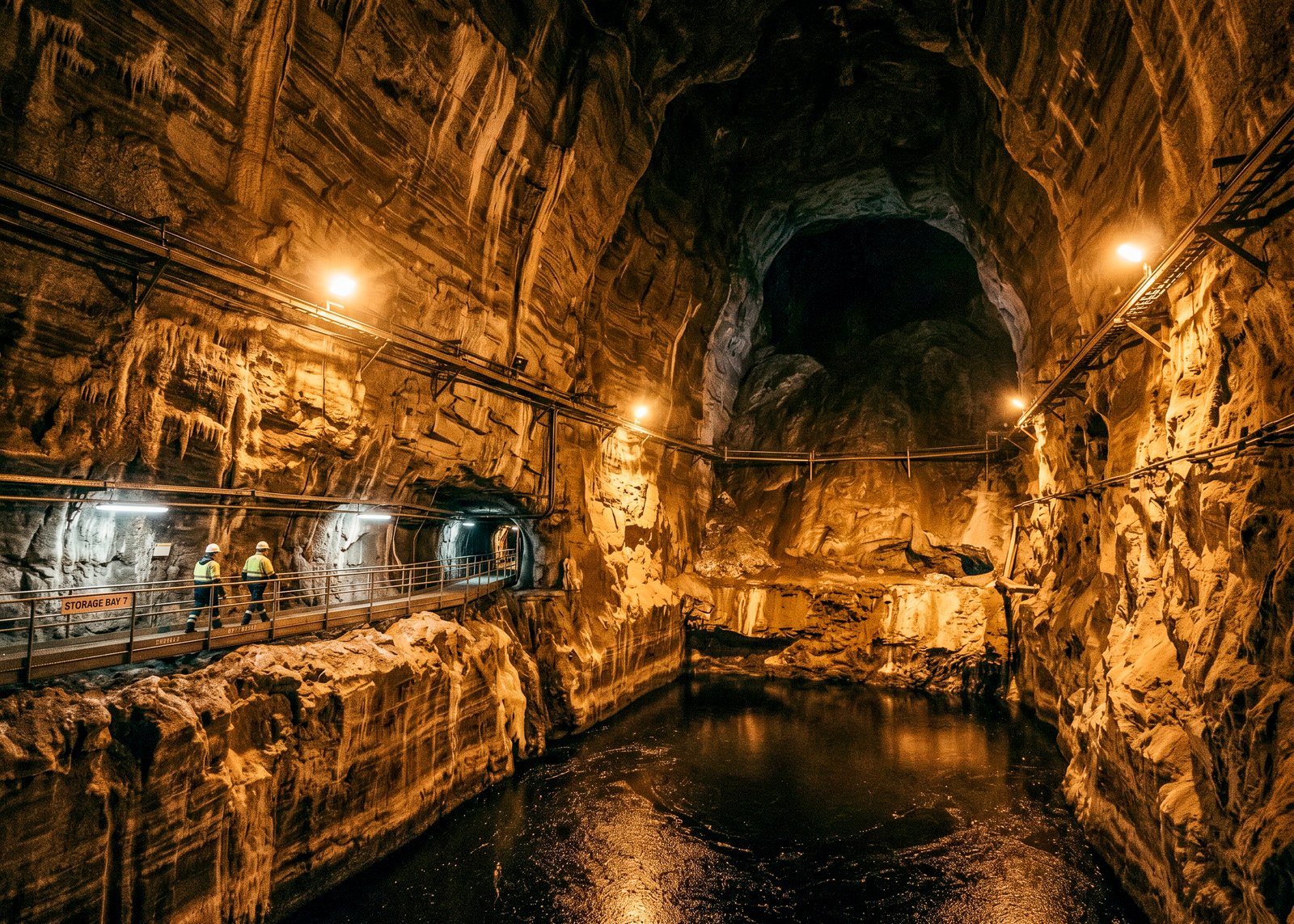
The world’s largest oil stockpiles — held by China, the United States, and Japan — are so massive that storing them in standard above-ground tanks is largely impractical. These strategic volumes are measured in hundreds of millions of barrels. To put that in perspective, one barrel equals 42 gallons, meaning China’s estimated 1.4 billion barrel reserve represents roughly 59 billion gallons of crude oil.
To store these volumes safely, securely, and affordably, governments look down rather than up. The primary methods fall into three categories.
Underground Salt Caverns — The United States
The U.S. Strategic Petroleum Reserve stores its entire federal stockpile in 62 massive underground salt caverns carved into natural salt domes along the Gulf Coasts of Texas and Louisiana. The reserve is authorized to hold up to 714 million barrels. Going into the current Hormuz crisis it held approximately 415 million barrels — roughly 57% of capacity.
The scale of these caverns is difficult to grasp. They sit 2,000 to 4,000 feet below the surface. A single cavern can be 2,500 feet deep and 200 feet wide — large enough to fit Chicago’s Willis Tower inside with room to spare.
How they are made: Engineers use a process called solution mining. They drill a well into a solid underground salt dome and inject large amounts of fresh water to dissolve the salt. The resulting brine is pumped out, leaving a perfectly sealed underground void.
Why salt works: Rock salt is entirely impermeable to crude oil, meaning oil cannot leak out or contaminate groundwater. Under immense geological pressure, salt behaves like a plastic and naturally self-heals any microcracks that form. Storing oil underground is also roughly ten times cheaper than building equivalent above-ground tank capacity.
Getting the oil out: Because oil floats on water, operators pump fresh water or heavy brine into the bottom of the cavern. This forces the oil upward and out through the wellhead at the surface.
Unlined Rock Caverns — Japan and China
Japan and parts of China lack the specific geological salt domes found along the American Gulf Coast. Instead, they rely on hard rock caverns — massive tunnels excavated directly into stable coastal bedrock.
To prevent oil from seeping into surrounding rock, engineers use a water curtain system. Natural groundwater pressure surrounding the cavern is maintained at a level higher than the pressure of the oil inside. This constant inward pressure keeps the oil strictly contained within the rock chamber.
Above-Ground Tank Farms — Japan and China
Underground storage is preferred, but massive above-ground systems supplement it — particularly for refined fuels like diesel and gasoline. China and Japan operate heavily secured coastal tank farms featuring rows of large steel tanks. Many use floating roofs that rise and fall with the oil level, preventing flammable vapors from building up in the empty headspace above the oil.
Japan has also built specialized storage terminals on remote coastal islands, including facilities at Shibushi and Kamigoto. These feature tanks built partially into the earth or positioned in protected marine bays, reducing vulnerability to earthquakes and tsunamis.
Who Holds the Most?
As of 2026, the global strategic reserve picture looks like this:
| Country | Estimated Strategic Stockpile | Primary Storage Method |
|---|---|---|
| China | ~1.4 billion barrels | Hard-rock caverns, above-ground tank farms, commercial storage |
| United States | ~415 million barrels (government) + ~439 million barrels (commercial) | Deep underground salt caverns |
| Japan | ~260 million barrels (government) + ~180 million barrels (commercial) | Coastal rock caverns, island tank farms |
In the next essay, we look at how long those reserves can actually last — and what the current Hormuz crisis has done to them.