April 4, 2026
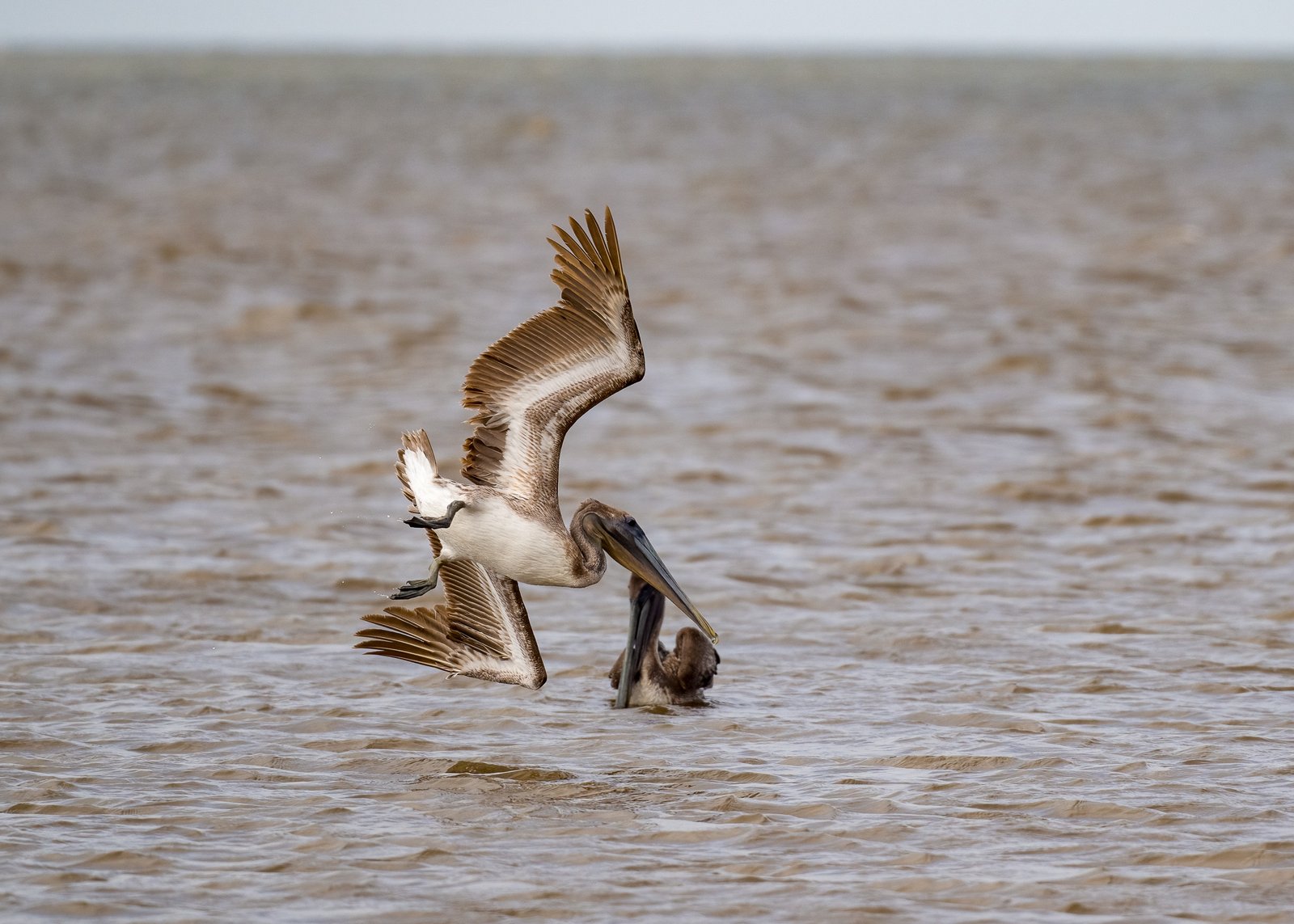
Pelicans seem to float on the air just above the water
Pelicans are able to “float” just above the water by using a physics principle called the ground effect. When they glide within one wingspan of the surface, they create a cushion of air that supports their weight and makes flight significantly more efficient.
How Ground Effect Works
When a pelican glides very low, the air moving beneath its wings interacts with the water’s surface in several ways:
- Compressed Air Cushion: Air becomes trapped or “funneled” between the wing and the water. Because this air has nowhere to go, it compresses, creating a high-pressure cushion that provides extra lift.
- Reduced Drag: Usually, swirling air (vortices) forms at the tips of a bird’s wings, which creates drag. Flying close to the water physically blocks these vortices from fully forming, allowing the pelican to glide further with less effort.
- Energy Conservation: By using this “free ride” from the air cushion, pelicans can save up to 40% of the energy they would otherwise need for flapping. This allows them to travel long distances while barely moving their wings.
Other “Floating” Techniques
While ground effect is their primary trick for skimming flat water, pelicans use other methods to stay aloft:
- Wave-Slope Soaring: Near the shore, pelicans use updrafts created by the physical shape of rising and breaking waves to stay airborne.
- Thermal Riding: Over land or warm water, they find columns of rising warm air (thermals) to gain height without flapping, often circling in groups to stay within the updraft.
The physical adaptations that help pelicans survive their high-speed dives into the water
To survive “plunge-diving” from heights of up to 60–100 feet at speeds of 40 mph, pelicans have evolved several high-performance internal and external features.
Internal “Airbags”
The most critical adaptation is a network of subcutaneous air sacs located beneath the skin on their breast and belly. Just before hitting the water, the pelican takes a deep breath to inflate these sacs, which act like a biological air mattress to cushion the impact and protect their internal organs. These sacs also make the bird extremely buoyant, causing them to “pop” back to the surface immediately after a dive.
Structural & Behavioral Shields
Pelicans use specific maneuvers and structural traits to prevent “breakneck” injuries:
- The “Lefty” Twist: As they dive, pelicans slightly rotate their bodies to the left. This is because their trachea and esophagus are located on the right side of their neck; the twist ensures these delicate tubes aren’t crushed by the force of the impact.
- Contoured Bill: Their sword-shaped bill is designed to slice into the water with almost zero “hydrodynamic drag,” similar to the difference between a palm slap and a karate chop.
- Muscle Tension: At the moment of impact, they shoot their wings back and tense powerful muscles around their spine to keep their neck from snapping.
- Eye Protection: A translucent third eyelid, called a nictitating membrane, slides over their eyes like built-in swim goggles to protect them from the water’s force while allowing them to keep their prey in sight.
The Parachute Pouch
The famous throat pouch isn’t just for holding fish; it acts as a brake. When it expands underwater, it creates a massive amount of drag that slows the bird’s momentum so it doesn’t dive too deep or hit the seafloor in shallow water.
The sophisticated filtering system they use to drain gallons of water from their pouch without losing their catchWhen a
pelican scoops up fish, it also captures up to 3 gallons (13 liters) of water. Because this much water can weigh nearly 25 pounds—more than the bird itself—they must drain it immediately before they can fly or even swallow their meal.
They use a precise “scoop-and-drain” method to separate the fish from the water:
- Muscle-Controlled Contraction: While a pelican’s tongue is very small, it is actually the tongue muscle that controls the pouch. After surfacing, the pelican contracts these muscles to squeeze the pouch, forcing water out.
- The Head-Tilt Technique: To let the water escape without losing the fish, the pelican tilts its bill downward and forward. It keeps the mandibles (the two halves of the bill) slightly parted, allowing the water to flow out of the corners of its mouth while the solid fish remain trapped inside.
- Internal Ribbing: The inner lining of the pouch (the gular pouch) is fibrous and stretchy, acting like a biological net. Once the water is gone, the bird tosses its head back to slide the fish down its throat head-first.
- Built-in Desalination: For any salt water they do accidentally swallow, pelicans have specialized salt glands above their eyes. These glands act like mini-kidneys, filtering excess salt from the blood and excreting it as a salty liquid that drips off the end of their bill.
This process usually takes less than a minute, but it’s a vulnerable time—other seabirds like gulls will often try to steal the fish right out of the pelican’s open bill while the water is still draining.
Pelicans cooperate in “squadrons” to herd fish into shallow water for easier scooping
Pelicans are one of the few bird species that practice communal fishing, often working in synchronized “squadrons” to outsmart schools of fish. Instead of competing, they use teamwork to create a living net.
The “U-Shape” Maneuver
A group of pelicans (usually 6 to 10) will form a wide semi-circle or U-shape on the water’s surface. They then swim steadily toward the shoreline, effectively “herding” the fish into the shallows where they have nowhere to hide.
Tactical Tools
To keep the fish moving in the right direction, the squadron uses two main tactics:
- Wing Beating: They synchronously beat their wings against the water’s surface. The loud splashing and vibrations create a “wall of sound” that panics the fish and drives them forward.
- Coordinated Dipping: Once the fish are trapped in shallow water or a tight ball, the pelicans all dip their massive bills into the water at the exact same time. This simultaneous strike makes it impossible for the fish to escape through the gaps between birds.
The “Pod” Advantage
By fishing together, each individual pelican actually catches more than it would alone. This strategy is particularly effective for American White Pelicans, who don’t plunge-dive like Brown Pelicans but instead stay on the surface to scoop up their prey.
Interestingly, they often share these fishing grounds with Cormorants. While the pelicans scout the surface, the diving cormorants drive fish up from the bottom, creating a “pincer move” that benefits both species.
How pelican parents manage to feed these massive amounts of fish to their chicks back at the nest
Feeding a growing pelican is a messy, high-energy job that involves a unique “serving style” and a very specialized diet called “fish soup.”
The “Fish Soup” Stage
When chicks are very young, they can’t handle whole fish. The parents swallow the prey, partially digest it in their stomachs, and then regurgitate a nutritious, soupy liquid. They dribble this directly into the chick’s small bill.
The “Deep Dive” Feeding
As the chicks grow, the feeding process becomes much more dramatic:
- Reaching In: Unlike most birds that drop food into a chick’s open mouth, pelican chicks actually stick their entire heads and necks deep into the parent’s throat pouch to scavenge for fish.
- The “Seizure” Dance: To a casual observer, it looks like the chick is attacking the parent. The chick will vigorously shake its head inside the pouch to stimulate the parent to cough up more food.
- Size Matters: By the time they are a few weeks old, chicks can swallow whole fish nearly as large as themselves.
Group Daycare (Crèches)
As the chicks get older and more demanding, the parents often huddle them together in large groups called crèches. This “daycare” system allows both parents to go out and fish at the same time to keep up with the massive amount of food needed—a single pelican chick can require up to 150 pounds of fish before it’s ready to fly.
Identifying “Their” Chick
Even in a crowded colony with hundreds of identical-looking babies, parents use unique vocalizations to find and feed only their own offspring. If a “stranger” chick tries to sneak a meal, the parent will usually peck it away.
Learning to plunge-dive is a high-stakes “sink or swim” moment for young pelicans, and it usually takes them several weeks to a few months of clumsy practice to get it right.
The Learning Curve
When a young pelican first leaves the nest (around 10–12 weeks old), it has the instinct to dive but lacks the precision. Their early attempts are often:
- Too Shallow: They don’t hit the water with enough force to reach the fish.
- Off-Target: They struggle to compensate for the “refraction” of light (the way water bends light, making a fish appear to be in a different spot than it actually is).
- Painful Belly-Flops: Without perfect timing, they often miss the “lefty twist” and smack the water flat, which can be disorienting or even injurious.
The High Mortality Rate
This period is the most dangerous time in a pelican’s life. Because they are no longer being fed by their parents, they must learn to hunt before their fat reserves run out. Sadly, many young pelicans starve during their first winter because the “plunge-dive” is such a technically difficult skill to master.
Social Learning
While much of the behavior is instinctual, young pelicans often watch older, more experienced birds. They will hang around active feeding groups, observing the timing and angles used by the adults to improve their own success rate.
Survival of the “Scavenger”
Until they become expert divers, many juveniles survive by scavenging—stealing fish from other birds or hanging around fishing piers and boats for “handouts” until their hunting skills catch up to their appetite.
How the different species of pelicans (like the Brown vs. the Great White) have evolved different ways to hunt based on their environment
While all eight species of pelicans share the iconic throat pouch, they have split into two distinct groups based on their environments: the
plunge-divers (Brown and Peruvian) and the surface-scoopers (the White species).
The Plunge-Divers (Brown & Peruvian)
These are the only pelicans that hunt from the air. Because they live primarily along saltwater coasts, their environment is often deep, turbulent, and full of fast-moving schools of fish like menhaden and sardines.
- The “Air Missile” Strategy: They fly high (up to 60 feet) to spot fish from above, using the height to gain speed and break the water’s surface tension.
- Physical Armor: Because of the high-impact nature of their hunt, they have evolved the “airbag” sacs and reinforced skulls mentioned earlier.
- Solo Hunting: While they may fly in groups, they usually dive individually once a target is spotted.
The Surface-Scoopers (Great White & American White)
These species primarily inhabit inland freshwater lakes, rivers, and shallow marshes. In these shallow environments, diving from 60 feet would be dangerous or impossible.
The “Living Net” Strategy: They use the cooperative herding technique we discussed, swimming in formation to drive fish into the shallows where they can easily scoop them up while floating.
- Massive Size: White pelicans are significantly larger than Brown pelicans. The American White Pelican can have a wingspan of up to 9 feet, making it one of the largest birds in North America.
- Buoyancy: Because they don’t need to pierce the water’s surface, they are built to be extremely buoyant, sitting high on the water like corks.
Environmental Specialization
| Feature | Brown Pelican | American/Great White Pelican |
| Primary Habitat | Marine/Coastal | Freshwater/Inland |
| Hunting Method | Plunge-diving from height | Cooperative surface scooping |
| Nesting Style | Primarily in trees/bushes | Exclusively on the ground |
| Body Size | Smaller, more aerodynamic | Very large, high wingspan |
Despite these differences, some species like the Great White Pelican are opportunistic; while they usually fish in groups, they have been known to fish solo if they are separated from their flock.