June 12, 2026
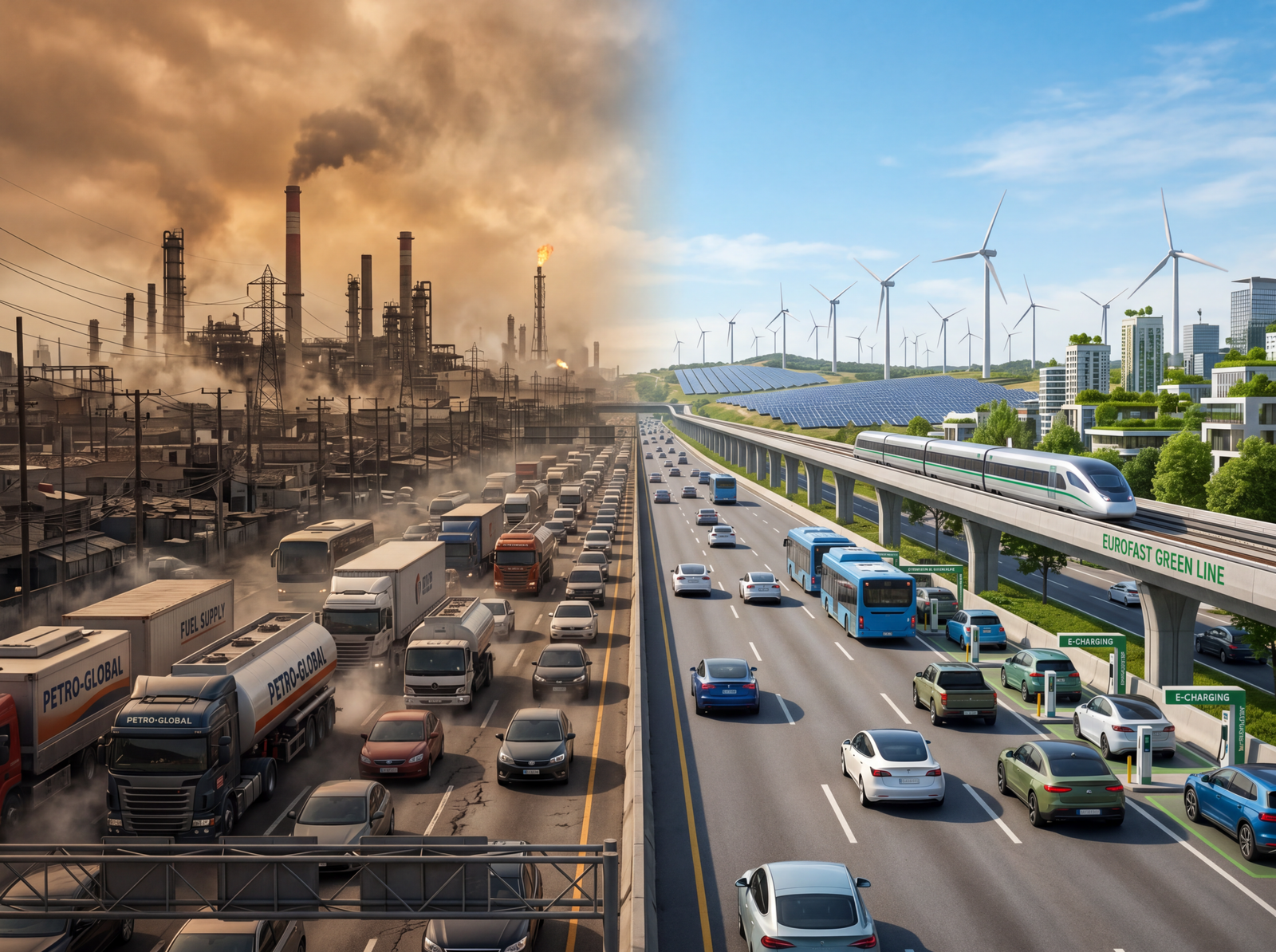
Three essays in, one thing is clear: the Strait of Hormuz crisis is not the story. It is the opening chapter. The real story is what the world does next — how we produce energy, store it, and whether we can loosen oil’s grip on everything from our commute to our food supply. That exploration begins with this essay.
For decades, reducing oil dependency was framed primarily as an environmental goal — the responsible thing to do for climate and ecological health. The Strait of Hormuz crisis has reframed that conversation entirely. When a single chokepoint can disrupt 20 percent of the world’s oil supply almost overnight, energy dependency stops being a long-term environmental debate and becomes an immediate economic and national security emergency.
The challenge is that oil is not simply a fuel. It is embedded in the foundations of modern life — transportation, manufacturing, agriculture, medicine, clothing. A realistic global transition does not mean flipping a switch. It means systematically replacing oil where the world depends on it most, starting with the highest-volume uses.
Transportation: The Largest Target
Roughly 57 to 60 percent of every barrel of oil produced globally goes toward moving people and goods. That concentration makes transportation both the biggest part of the problem and the most practical place to begin.
Electric vehicles represent the most mature near-term tool for cutting petroleum demand in personal travel and urban freight. For EVs to make a meaningful global dent, however, they require something most of the developing world does not yet have: reliable fast-charging infrastructure and electrical grids capable of handling the additional load. The technology exists. The infrastructure buildout is the bottleneck.
For freight, the transition is more complex. Electric trucks work well for shorter urban deliveries. Long-haul trucking — the backbone of global supply chains — poses a harder engineering problem. Hydrogen fuel cells, which generate electricity through a chemical reaction and emit only water vapor, are the leading candidate for heavy, long-distance commercial transport.
Expanding electrified passenger and freight rail provides another lever, though the global picture varies considerably by region.
Japan’s Shinkansen network, launched in 1964, now carries more than 150 million passengers annually. China has constructed over 40,000 miles of high-speed rail in roughly two decades — the largest such network on Earth. Across Europe, interconnected systems link major cities from Madrid to Berlin to Paris, moving hundreds of millions of passengers each year and pulling significant traffic off congested highways and out of short-haul air routes.
The United States presents a different picture. America actually operates the world’s largest freight rail network by total mileage — a system built over 150 years to move bulk cargo like grain, coal, and manufactured goods across vast distances with impressive efficiency. Passenger rail, by contrast, has received far less investment. Amtrak serves major corridors, but with frequency and travel times that rarely compete with driving. The Northeast Corridor between Boston, New York, and Washington remains the one genuine exception, where rail ridership competes directly with air travel.
The gap is not simply a matter of geography or population density. It reflects generations of infrastructure investment decisions — and it represents one of the clearest remaining opportunities for reducing transportation oil demand at scale.
The Hard-to-Abate Sectors
Aviation, ocean shipping, and heavy industry share a common problem: they require so much energy at such high intensity that batteries cannot currently meet the demand. A commercial aircraft cannot carry enough battery weight to cross an ocean. A cargo ship burning heavy fuel oil on a trans-Pacific voyage is powered by an energy source no lithium-ion battery pack can yet replace at scale.
For aviation, sustainable aviation fuels — known as SAFs — offer the most viable near-term path. These are fuels produced from agricultural waste, used cooking oils, or synthetic processes that capture carbon dioxide and hydrogen. Critically, SAFs work in existing jet engines without any modification to aircraft or airport infrastructure.
For ocean shipping, the leading alternatives are green ammonia and methanol, both of which can be produced using renewable energy. Major shipping companies and port authorities are already piloting these fuels, though the economics remain challenging compared to conventional bunker fuel.
In heavy industry — steel mills, cement plants, chemical manufacturing — the heat requirements are so extreme that only two realistic alternatives exist: high-temperature electric furnaces powered by clean electricity, or green hydrogen burned directly as a fuel.
Beyond Fuel: The Petrochemical Problem
Approximately 12 percent of global oil production is never burned as fuel at all. It is converted into the raw material for plastics, fertilizers, synthetic fibers, and industrial chemicals. This portion of oil demand is often overlooked in energy transition discussions, and it is growing — not shrinking — as other sectors electrify.
Two approaches offer a path forward. Bio-based plastics, made from plant materials like cornstarch, sugarcane, or algae, can replicate the properties of petroleum-based plastics while breaking down naturally. Advanced chemical recycling, still in early commercial development, breaks used plastics down to their molecular components so they can be rebuilt into new materials without requiring fresh oil. Neither solution is ready for full industrial scale today. Both are closer to that threshold than they were five years ago.
Designing Oil Out of Daily Life
Sometimes the most effective way to reduce oil dependency is not to replace it with something else, but to eliminate the need for it at the system level.
The “15-minute city” concept — designing neighborhoods so that work, groceries, healthcare, and leisure are all within a short walk or bike ride — fundamentally changes the transportation calculus. If you do not need to drive to live your daily life, the question of what powers the vehicle becomes far less urgent.
Remote and hybrid work policies, accelerated globally by the pandemic and now embedded in many economies, have produced a lasting reduction in peak-hour commuter traffic that no amount of EV adoption could have achieved as quickly.
These behavioral and structural shifts do not generate the same headlines as billion-dollar battery factories. In terms of barrels of oil removed from daily demand, they are among the most efficient tools available.
The critical question raised by all of these strategies is the same: if we electrify transportation and industry at scale, where does all the electricity come from? That is the subject of the next essay.
Nice essay Rich. The options are there but what will ultimately be the catalyst that will propel us into this better future? If climate change is not that, what is?
Security, a sense of self reliance AND GREED, always money and greed!