July 7, 2026
Every energy source this series has examined so far — oil, batteries, solar, wind, nuclear — draws on something that can run out, degrade, or be blocked at a chokepoint. The earth’s internal heat is different. It has been radiating outward since the planet formed, it will continue doing so for billions of years, and it is present everywhere beneath our feet, though not equally easy to reach or use.
The challenge has never been whether the heat exists. It has always been reaching it.
That challenge is now being solved in ways that were not commercially viable five years ago — and the results are beginning to show up not just in research papers but in real projects delivering real electricity to real grids.
Three Eras of Geothermal
To understand where geothermal is going, it helps to see where it has been.
The first era — conventional hydrothermal — requires three naturally occurring conditions to align simultaneously: heat, water, and rock permeable enough to let that water move. Where all three exist together, geothermal plants have operated reliably for decades. Iceland uses geothermal extensively for both electricity and heating. New Zealand generates significant power from it. The western United States has a small but steady conventional fleet.
The constraint is geography. This specific combination is geologically rare, which is why conventional geothermal provides only about 2.7 gigawatts of U.S. generating capacity — roughly 0.2 percent of the national total.
The second era removes the water and permeability requirements.
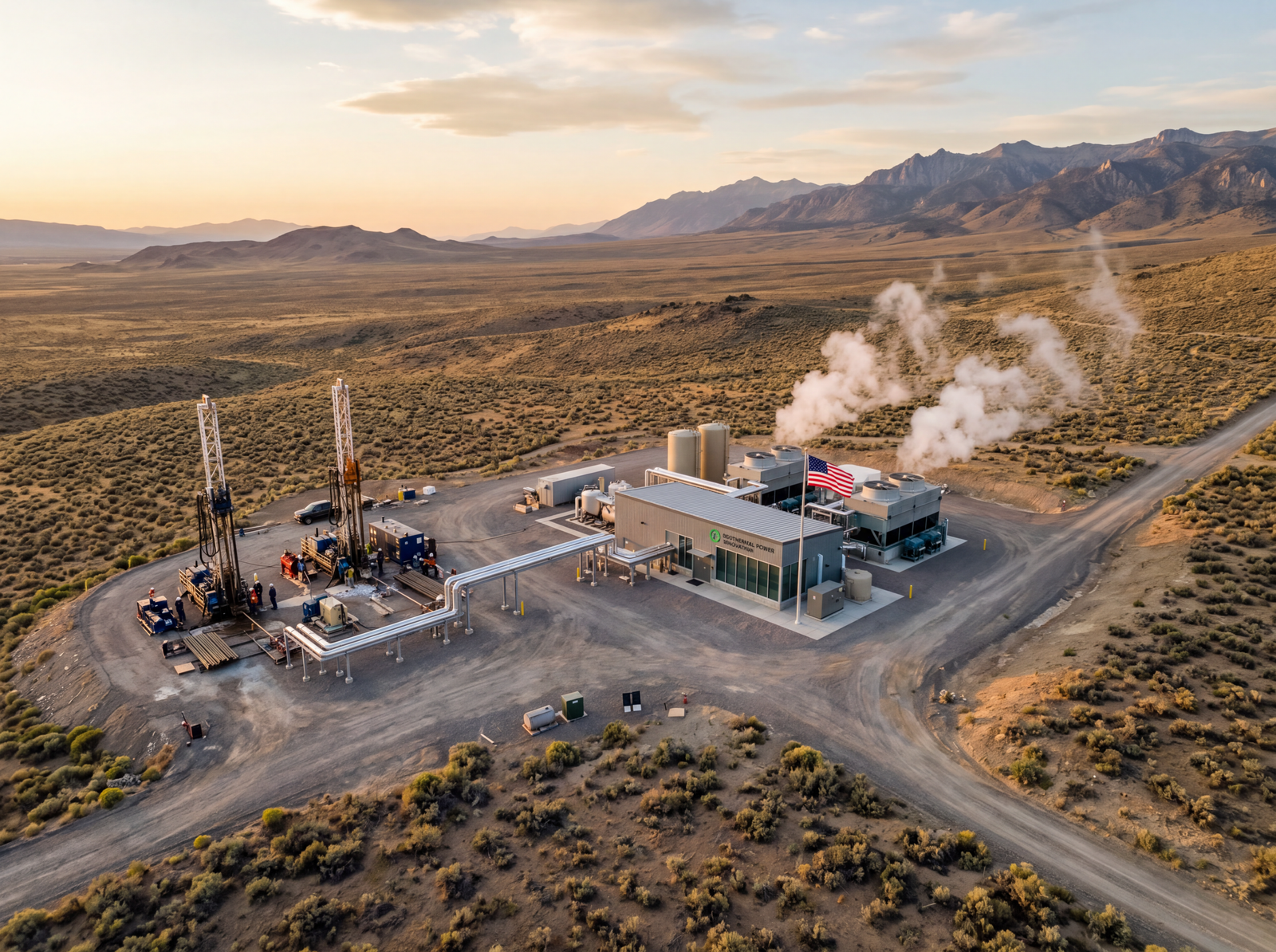
Enhanced Geothermal Systems, or EGS, work with hot dry rock — the kind of deep, impermeable crystalline basement rock that exists nearly everywhere beneath the surface, not just near volcanoes or tectonic boundaries. Engineers drill down into that rock, then use directional horizontal drilling and hydraulic stimulation — techniques transferred almost directly from the oil and gas industry — to create an artificial fracture network. Water is pumped down an injection well, migrates through the engineered fractures absorbing heat, and returns to the surface through a production well as superheated water or steam.
The third era, called Advanced Geothermal Systems or closed-loop, goes further still. Rather than exchanging fluid with the rock at all, a sealed network of pipes is drilled underground and a closed-loop working fluid circulates entirely within those pipes, picking up heat through conduction and returning to the surface without ever touching the surrounding rock formation. It functions, in essence, as a deep subterranean radiator.
The Technology Transfer That Changed Everything
What unlocked EGS as a commercial proposition was not a single invention. It was the systematic application of techniques the oil and gas industry spent decades perfecting — horizontal drilling, hydraulic fracturing, real-time downhole sensing — to a completely different problem.
That transfer is visible in the numbers. In 2021, the Department of Energy’s FORGE research site in Utah was drilling at roughly 8 meters per hour into hard basement rock. By 2024, that rate had nearly doubled to close to 15 meters per hour, with peak rates reaching 26. Fervo Energy, a Houston-based company that has become the leading private developer of next-generation geothermal, has achieved sustained drilling rates of 30 meters per hour at its commercial project sites. Combined with new materials and real-time sensor data, the IEA reports that well construction costs have fallen by up to 30 percent and asset lifetimes may extend beyond 25 years.
What’s Actually Being Built
This is not still theoretical.
Fervo Energy’s Cape Station project in Beaver County, Utah, is the first large-scale commercial EGS development in the United States. Phase I is on track to begin delivering power to the grid in late 2026, reaching approximately 100 megawatts by early 2027, with Phase II targeted for 2028 and the full project scaling to 500 megawatts — making it the largest next-generation geothermal development in the world once complete. Fervo raised $462 million in private funding in December 2025, with investors including Google, Devon Energy, and Breakthrough Energy Ventures, then went public in May 2026.
Meanwhile, in Oregon, Mazama Energy’s Newberry Project accomplished something that had never been done before: it successfully fractured superhot rock at temperatures reaching 629 degrees Fahrenheit — deep enough and hot enough that water at that pressure enters a supercritical state, carrying up to ten times the energy of ordinary steam. That milestone matters because superhot systems could dramatically reduce the number of surface wells needed per megawatt, which is the single largest cost driver in geothermal development.
The Scale of What’s Possible
The U.S. Department of Energy’s Enhanced Geothermal Shot analysis projects that EGS could deliver 90 gigawatts of clean capacity in the United States by 2050 — enough to power the equivalent of more than 65 million American homes, and roughly a 20-fold increase from today’s conventional geothermal fleet. The U.S. Geological Survey separately estimates that the Great Basin of the American Southwest alone holds 135 gigawatts of EGS potential. The DOE’s most recent next-generation geothermal report identifies as much as 300 gigawatts of theoretical potential nationwide, depending on storage integration and continued cost reductions.
A 2025 Princeton University study projected that geothermal could supply up to 20 percent of U.S. electricity by 2050. The IEA estimates it could meet 15 percent of global electricity growth through that same horizon, while also providing heat to industry and buildings.
Why It’s Baseload
The word that keeps appearing in geothermal discussions — baseload — deserves a plain explanation. Solar generates electricity when the sun shines. Wind generates when the wind blows. Geothermal generates continuously, around the clock, regardless of weather, season, or time of day. That is what baseload means: power that is always there.
This makes geothermal particularly valuable in a grid increasingly dependent on intermittent sources. It also makes it attractive to technology companies building AI data centers, which require enormous, uninterrupted power supplies. Several major technology firms have already signed power purchase agreements with geothermal developers specifically for this reason. Fervo’s partnership with Google, which began with an earlier Nevada project, is among the most visible examples.
More Than Electricity: The Lithium Connection
There is a quiet bonus running through the geothermal story that ties directly back to the battery essays earlier in this series. Deep geothermal brines — the hot, mineral-rich fluids circulated through EGS systems — often contain significant concentrations of lithium, the same mineral whose mining in the Chilean desert carries such severe environmental costs.
Geothermal projects currently under development in the European Union and the United States could yield 47 kilotonnes of lithium per year by 2035, according to IEA analysis — enough to meet 5 percent of projected global demand. This is not theoretical: Germany’s Vulcan Energy has already secured lithium offtake agreements with Glencore, Stellantis, LG Corp, and Umicore from its Lionheart geothermal project, which fully secured financing in 2025. Extracting lithium from geothermal brine produces no new mining footprint, uses no additional water, and generates no additional surface waste — a meaningful contrast to traditional lithium extraction.
The Real Obstacles
Geothermal’s challenges are genuinely different from those facing solar or wind, and worth understanding clearly.
The largest single obstacle is upfront cost and risk.
Unlike a solar farm, where output can be modeled with reasonable accuracy before a single panel is installed, geothermal requires millions of dollars in exploratory drilling before the exact heat yield, rock behavior, and reservoir longevity of a site can be verified. That uncertainty makes early-stage financing difficult to secure. The DOE’s recent $171.5 million funding announcement for next-generation geothermal field tests exists specifically to reduce that exploratory risk — providing public capital to de-risk sites that private investors won’t yet touch.
The second challenge is induced seismicity.
Hydraulic stimulation — injecting high-pressure fluids to open rock fractures — carries a risk of triggering minor, localized seismic events. The engineering response involves careful monitoring of reservoir pressure and geophysical stress, and the seismic events involved are generally small. But the public perception and regulatory response to any felt earthquake near a geothermal project can be significant, as several European EGS projects have discovered. This remains an area where careful site selection and transparent community communication are operational requirements, not optional extras.
The third challenge is efficiency loss.
Pumping large volumes of water miles underground requires substantial electricity, reducing net plant output. Deep geothermal fluids are also highly saline and corrosive, requiring expensive metallurgical materials for well casings and heat exchangers.
State of Play, as of July 2026
This field is moving fast enough that specific figures will date quickly. As of this writing: investment in next-generation geothermal reached nearly $2.2 billion globally, marking an 80 percent year-over-year increase, per IEA data. The share of debt financing has grown significantly as investors gain confidence — a sign of a technology maturing from venture-backed experiment toward infrastructure-grade asset. Thirty U.S. states now offer some form of geothermal incentive. Fervo’s Cape Station is on track to begin delivering power to the grid later this year. The DOE’s $171.5 million geothermal field test funding opportunity closed for applications in May 2026, with awards expected later this year.
What This Means
Geothermal energy’s opportunity is not new. The earth’s heat has always been there. What is new is the combination of technologies — borrowed largely from oil and gas — that now make it accessible far beyond the volcanic hotspots where it has historically been confined. The drilling is faster. The costs are falling. The first large-scale commercial projects are moving from blueprints into operating assets.
The same data center demand driving investment in small modular reactors is driving investment in geothermal, for the same reason: both provide what solar and wind cannot — power that is always on. Whether geothermal reaches its projected potential depends on how quickly drilling costs continue to fall, how well the industry manages the seismicity challenge, and whether regulatory pathways keep pace with technical progress.
Geothermal draws its energy from deep within the earth. The next essay in this series looks at a fuel source manufactured from the most abundant element in the universe: hydrogen.