July 3, 2026
The previous two essays in this series looked at policy — the incentives, regulations, and decisions that explain why some countries have moved faster than others toward alternatives to oil. Policy explains a great deal. It does not explain everything. The technology itself is also changing, often faster than the policy built around it. Nowhere is that more visible right now than in nuclear power.
For decades, nuclear meant one thing: enormous plants, gigawatt-scale, taking a decade or more to build, anchored to a handful of locations near major waterways. A new category of reactor is challenging nearly every part of that picture.
What Makes a Reactor “Small” and “Modular”
A small modular reactor, or SMR, is defined primarily by output: up to 300 megawatts of electricity per unit, compared to the 1,000 to 1,600 megawatts a traditional reactor typically produces. Some designs, called microreactors, scale down further still, to as little as 1 to 10 megawatts. To put 300 megawatts in perspective, it is enough to power roughly 300,000 homes.
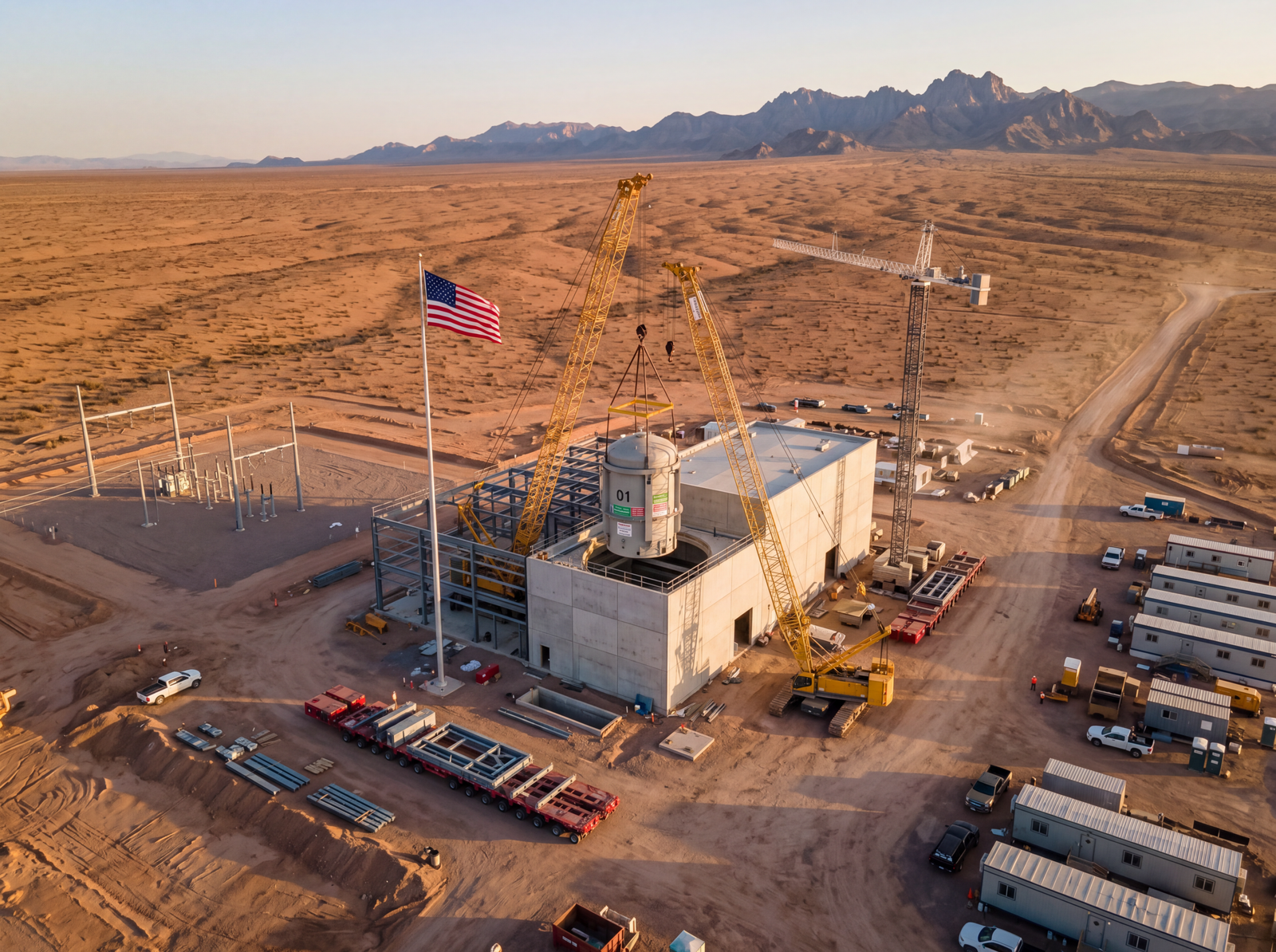
The “modular” part describes how they are built. Traditional nuclear plants are largely constructed on-site, piece by piece, in a process notorious for delays, weather disruptions, and custom engineering fixes unique to each location. SMRs flip that approach: the reactor and its core components are built and sealed inside a factory, then shipped by truck, rail, or barge to the site, where the main work becomes pouring concrete and connecting completed modules. The aim is to trade the old economics of scale — bigger is more efficient — for the economics of mass production — identical units, built repeatedly, getting cheaper each time.
Reactor design has also diversified. Where the existing global fleet is overwhelmingly composed of light water reactors, SMRs branch into several different cooling and moderating approaches, including high-temperature gas-cooled, liquid metal, and molten salt designs. Each carries its own tradeoffs in safety, fuel type, and the kind of heat or power it can produce.
A Different Approach to Safety
Traditional reactors rely on active safety systems — pumps, backup generators, and human intervention to keep cooling water moving during a shutdown. Most SMR designs lean instead on passive safety: physics alone, through gravity, natural convection, and built-in heat sinks, intended to bring the reactor to a safe state without external power or human action. Combined with their smaller footprint, this also allows SMRs to be sited in places a traditional plant never could be — remote locations, industrial sites, or built partly below ground.
Proof That the Construction Philosophy Works
The clearest illustration yet of how differently SMRs can be built came this spring in Idaho. In March 2026, a company called Aalo Atomics unveiled a completed Critical Test Reactor at Idaho National Laboratory — the first new reactor facility built there in fifty years. Six months earlier, the site had been an empty field. According to Aalo, the reactor itself was assembled in roughly forty days, and the building housing it in just over a month.
It is worth being precise about what that milestone actually represents. This is a test facility, built to validate the underlying technology and reach what nuclear engineers call criticality — a self-sustaining nuclear chain reaction at very low power — not a commercial power plant generating electricity for the grid. Aalo’s full commercial reactors remain years away. But the overall construction timeline has been confirmed by independent industry reporting, and it stands in stark contrast to an industry where projects routinely take the better part of a decade to break ground, let alone finish.
Proof That It Also Remains Genuinely Hard
If Idaho shows the promise, Ontario shows the cost.
Canada’s Darlington New Nuclear Project is building the first of four planned SMRs at a site already home to a traditional nuclear plant. As of May 2026, the foundation for the first unit — a 953-tonne slab of steel and concrete — has been physically set in place, making this the first SMR construction project in the Western world to move from planning into the ground.
The price tag is substantial: the first unit alone is budgeted at roughly $6.1 billion Canadian, plus another $1.6 billion in shared infrastructure, with the full four-unit program projected at $20.9 billion. That is the reality of being first: enormously expensive prototypes, even when the long-term promise is mass-produced units that cost progressively less. Ontario’s own utility is counting on exactly that pattern, pointing to its experience refurbishing Darlington’s existing reactors, where the second unit’s construction time dropped by 250 days compared to the first.
Whether that pattern holds for an entirely new reactor type, built for the first time, remains to be proven. The first unit is the test. The rest depends on what it teaches.
Why the Interest Now
The explosive growth of artificial intelligence has changed the conversation. Modern AI data centers require enormous amounts of electricity, around the clock, and utilities are struggling to add reliable generating capacity quickly enough. For companies building these facilities, an SMR located beside a data center has become an attractive possibility. Several major technology companies have already signed agreements to secure future SMR capacity for exactly this purpose.
Where the Real Obstacles Remain
Three challenges stand between SMRs and widespread deployment.
The first is cost, already visible in Darlington’s first-of-a-kind price tag. The promised savings come from repetition, and repetition has not happened yet.
The second is regulation. Nuclear regulatory frameworks were built around evaluating large light-water reactors. Updating them to handle fundamentally different designs — molten salt, fast-neutron, gas-cooled — remains a slow, case-by-case process, even as agencies work to accelerate it.
The third is fuel. Many of the most advanced SMR designs depend on a more highly enriched fuel called HALEU, and right now, Russia is the world’s only commercial-scale supplier of it. The United States banned imports of Russian uranium in 2024, with a full cutoff scheduled for 2028, and has since committed $2.7 billion toward building domestic enrichment capacity. Until that capacity exists, fuel availability remains a real constraint on how quickly these reactors can scale.
The Waste Question
SMRs do not solve nuclear power’s oldest unresolved problem: what to do with the waste. Reactors using standard light-water designs still produce spent fuel that remains highly radioactive for thousands of years, requiring years in cooling pools followed by long-term dry cask storage. Some independent studies suggest that, because of their smaller core size, certain SMR designs may actually generate more low- and intermediate-level waste per unit of electricity than large traditional plants — a real tradeoff, not a marketing footnote.
A small number of advanced designs, particularly molten salt and fast-neutron reactors, are theoretically capable of using already-spent fuel as their own input, reducing the volume of long-lived waste. But the chemical reprocessing this requires creates its own separate, highly corrosive waste stream that still needs permanent disposal. In the United States, that permanent disposal solution does not yet exist: more than 90,000 metric tons of spent nuclear fuel currently sit in temporary storage across 39 states, a problem SMRs will not resolve and, if deployed widely, will modestly add to.
State of Play, as of June 2026
This is a fast-moving field, driven heavily by data center demand, and some of the specific figures here will likely be outdated within months. As of this writing: over 125 SMR designs are in some stage of global development, with seven operating or under construction and roughly 50 more in licensing. The U.S. Nuclear Regulatory Commission is expected to issue its first commercial SMR construction permits sometime in 2026. Aalo Atomics expects its Idaho test reactor to reach criticality before July 4, 2026. Darlington’s first unit is targeted to connect to Ontario’s grid by the end of 2030.
What This Means
Small modular reactors are not a settled success story, and they are not a failed experiment either. They are a genuine, fast-moving bet — backed by real construction, real money, and real regulatory urgency — that nuclear power’s next chapter looks fundamentally different from its last one: smaller, faster to build, and increasingly aimed at powering the computing infrastructure now driving so much of the world’s electricity demand.
Nuclear is only one front in the search for cleaner, more resilient energy. Deep beneath the surface of the earth itself, a much older source of heat is also getting renewed attention. That is where this series turns next.