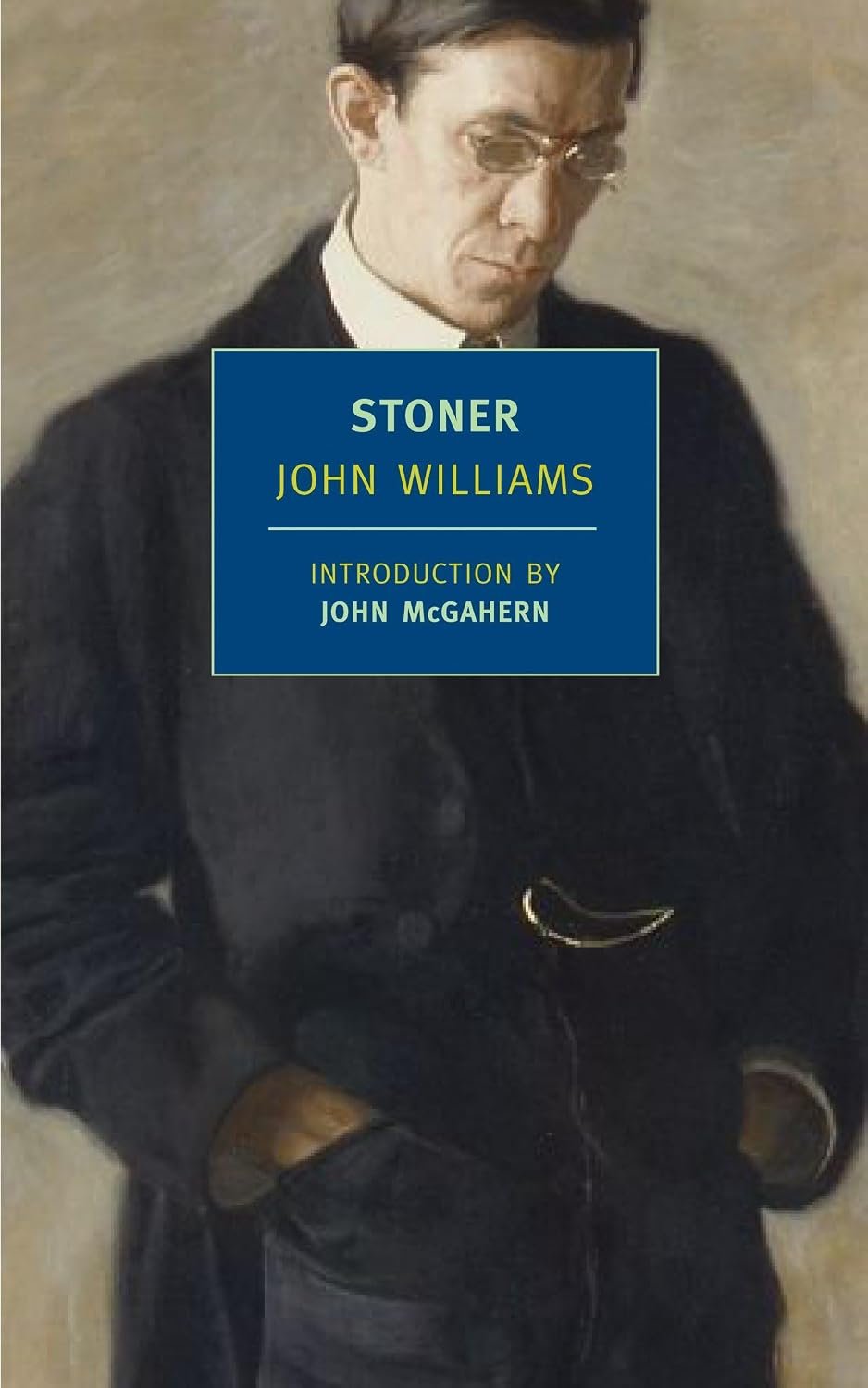
By John Williams
Genre: Literary Fiction / Campus & Academic Novel / Existential Realism
Audio Availability: Robin Field’s narration of Stoner is a solid, clean performance.
Categories: The Human Condition & The Visual Palette
📖 The Blueprint (No-Spoiler Synopsis)
Born to impoverished dirt farmers in rural Missouri at the close of the nineteenth century, William Stoner is sent to the state university in 1910 to study agricultural science so he can return and manage the family farm. Instead, an encounter with Shakespeare’s Sonnet 73 in an introductory literature survey derails his predetermined trajectory. Captivated by language and ideas, he abandons agriculture, pursues an academic life, and eventually becomes an assistant professor of English.
Stoner charts the unflashy, workaday trajectory of that life over the next four decades. It chronicles an emotionally barren, combative marriage; the quiet joy and subsequent loss of connection with his daughter; a bitter, entrenched departmental feud with a vengeful department chair; and a brief, transformative late-career love affair. Stoner leads an outwardly unremarkable existence—he never rises high in the academic hierarchy, never goes to war, and leaves little behind. Yet within the walls of his study and classroom, his quiet devotion to truth and literature becomes a profound, heroic act of endurance.
🌟 Reason to Read: The Technical Appeal
- Prose Built on Absolute Economy: John Williams writes with total clarity and zero excess ornament. Every sentence is balanced, calm, and measured. Like looking through an impeccably ground lens, the prose doesn’t call attention to itself; it simply reveals the exact contours of human experience with astonishing precision.
- The Anti-Melodrama: The book avoids every trap of sensationalized tragedy. Stoner’s disappointments—marital, professional, and personal—are not catastrophic explosions; they are the slow, realistic erosion of expectations that most human beings actually navigate. It treats ordinary stoicism with profound dignity.
- The Mechanics of Purpose: At its core, the novel examines what makes a life meaningful when stripped of status, public triumph, or conventional success. Stoner’s quiet integrity in the face of petty academic politics and personal grief makes it one of the most moving portraits of a working intellect ever put on paper.
⭐ Critical Consensus & Review Highlights
- The New Yorker:“A masterpiece… Stoner is written in the most plainspoken of styles, yet it builds an emotional resonance so intense it takes your breath away. It is simply a novel about a guy who goes to college and becomes a teacher. But its very ordinariness is what makes it universal.”
- C.P. Snow:“A work of absolute, quiet brilliance. Williams has taken the most modest life and transformed it into a work of art as clear and clean as running water.”
- The New York Times Book Review (Morris Dickstein):“One of the great forgotten American novels… It does something that very few books can do: it depicts goodness and devotion without a shred of sentimentality.”
🤝 My View: Placement for Book Shelf
Stoner belongs squarely under The Human Condition (Raw & Transformative), with strong ties to The Visual Palette due to the sheer architectural beauty of Williams’s sentences.
If you appreciated the unsparing honesty of John Daniel’s Looking After, Stoner will hit that exact same register. It contains zero melodrama, zero self-pity, and a steady, dignified acceptance of human limitation. It is widely considered a “writer’s novel” and one of the finest quiet masterpieces in modern American literature.