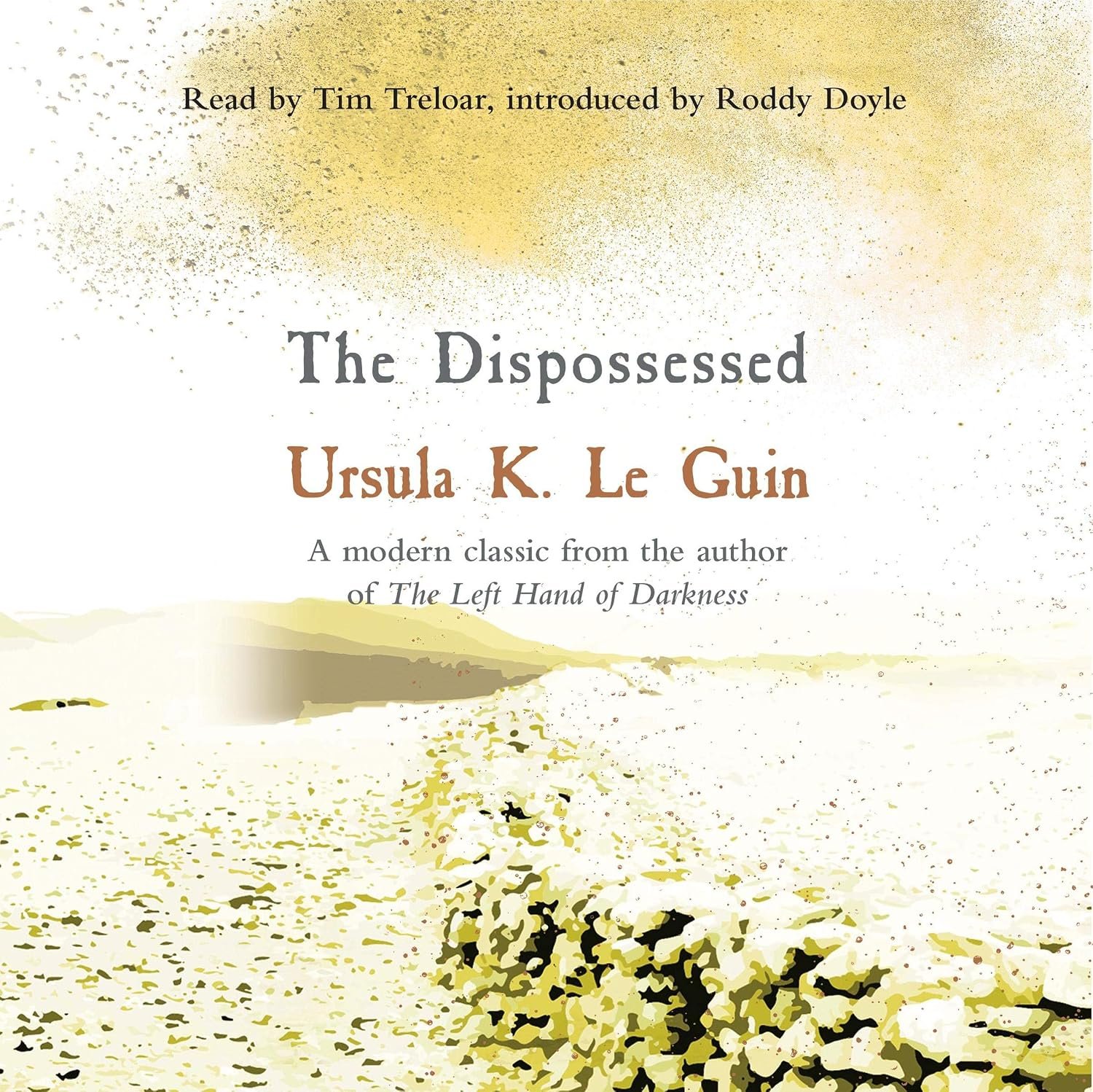
By Ursula K. Le Guin
Genre: Philosophical Science Fiction / Political Speculative Fiction
Audio Availability: Excellent narration by Don Leslie (deliberate, resonant, clear)
Categories: The Mechanics of Morality & The Inventions & Problem Solvers
📖 The Blueprint (No-Spoiler Synopsis)
Two worlds orbit each other in a fragile cold war. Urras is a planet of lush abundance, immense wealth, and stark capitalist and authoritarian divides. Its arid moon, Anarres, was settled nearly two centuries earlier by anarcho-syndicalist exiles who built a classless, moneyless, communal society carved out of severe ecological scarcity.
Shevek, a brilliant theoretical physicist from the austere moon, has developed a revolutionary theory of temporal physics that could enable instantaneous communication across interstellar distances (the Ansible). However, he finds his breakthrough blocked by bureaucratic jealousy and the subtle conformist pressures of his supposedly “free” society. Risking treason, Shevek travels to Urras—the first of his people to do so in generations—hoping to share his physics openly. Instead, he finds himself ensnared in a web of academic vanity, political espionage, and social decadence, forcing him to weigh the true mechanics of human freedom on both worlds.
🌟 Reason to Read: The Technical Appeal
- The “Ambiguous” Framework: Le Guin does not write propaganda. She gives Anarres genuine operational flaws (group-think, informal hierarchies, resource bottlenecks) while presenting Urras with real beauty alongside its grotesque inequalities. It is an intellectual stress test, not a lecture.
- Physics as Philosophy: The physics of time and simultaneity serve as a structural metaphor for human memory, obligation, and connection. It engages the mind like a complex engineering problem.
- Zero Melodrama: Shevek is a quiet, thoughtful protagonist—an observer who evaluates social systems with the objective detachment of a field scientist.
⭐ Critical Consensus & Review Highlights
- Theodore Sturgeon (Galaxy Science Fiction):“A marvelous, deeply thoughtful novel… Le Guin’s brilliance is that she does not construct a fairy tale. Her utopia is practical, hard-bitten, and intensely human.”
- The Washington Post Book World:“A rare achievement: a novel of ideas that never loses its pulse. Le Guin writes with crystalline prose and unmatched moral weight.”