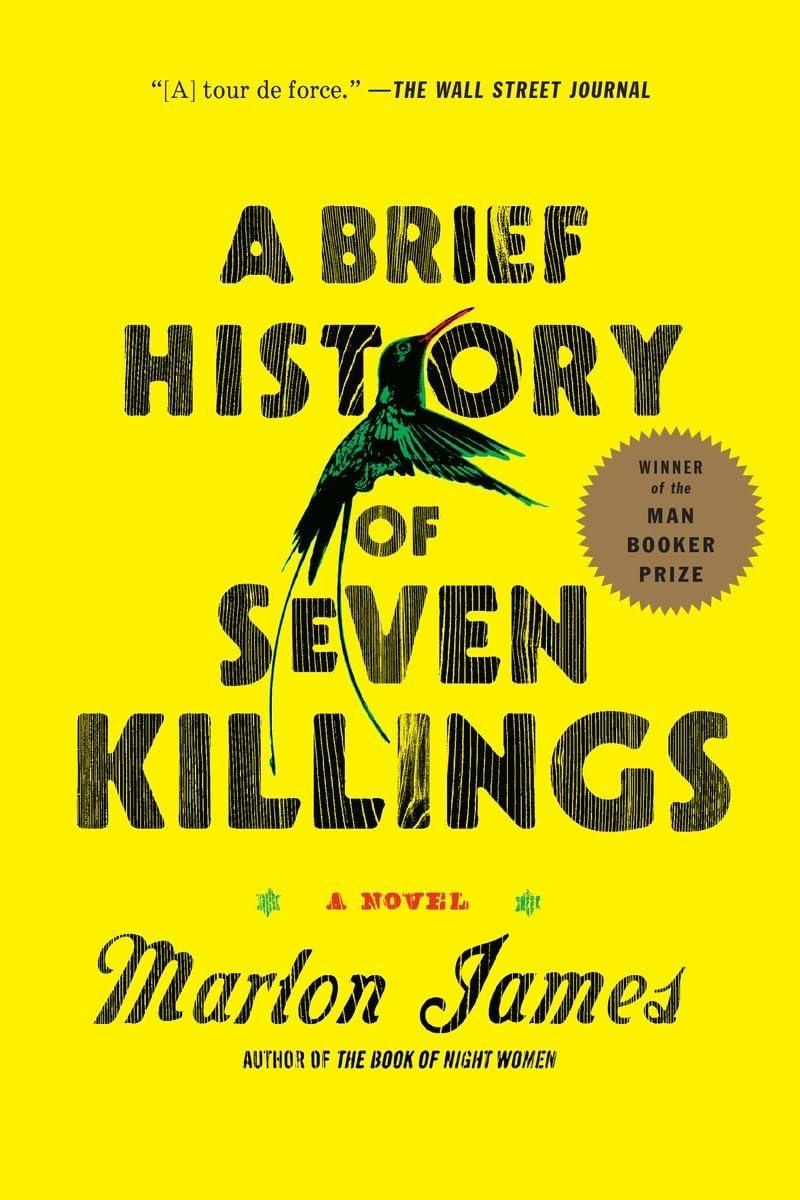
By Marlon James
Genre: Historical Fiction / Crime Epic / Political Noir
Category: The Ledger of Human Nature & The Visual Palette
📖 The Blueprint (No-Spoiler Synopsis)
On December 3, 1976, just two days before a major peace concert organized to ease escalating gang and political warfare in Kingston, Jamaica, seven gunmen stormed the compound of reggae icon Bob Marley (referred to throughout the text simply as “The Singer”). Marley, his wife, and his manager survived the spray of machine-gun fire; the gunmen vanished into the night.
A Brief History of Seven Killings begins with this real-world assassination attempt and tracks its shockwaves across three decades. Spanning Kingston’s rival tenement garrisons in the 1970s, the crack-cocaine epidemic in 1980s New York and Miami, and the hardened aftermath of the late 1990s, the novel documents how local gang disputes became entangled with Cold War geopolitics, CIA operations, and international narcotics pipelines.
Told through a chorus of more than seventy distinct voices—gang lieutenants, CIA field operatives, neighborhood street hustlers, foreign journalists, and even the dead—it is a panoramic, multi-layered audit of violence, power, and survival.
🌟 Reason to Read: The “Observer’s” Rationale
- A Masterclass in Polyphonic Voice: James constructs a massive oral-history framework where each character speaks in an entirely distinct register—from dense Jamaican patois and street slang to detached bureaucratic memos and sharp New York reportage. The linguistic rhythm drives the narrative like a train.
- The Geopolitical Ledger: It strips away romanticized notions of the Cold War and the Caribbean. James maps the cold, transactional machinery showing how superpower intelligence agencies weaponized localized poverty and gang loyalties, presenting history as an exacting balance sheet of cause and effect.
- Zero Sentimentality: Much like Cormac McCarthy’s unvarnished style, James refuses to soften the edges of human nature or construct easy heroes. He trusts the reader to witness the machinery of systemic corruption without a moralizing sermon.
⭐ Critical Consensus & Review Highlights
- The New York Times:“It’s epic in every sense of that word: sweeping, mythic, over-the-top, colossal and dizzyingly complex… It makes you think of The Godfather, The Wire, and Quentin Tarantino, but it is entirely Marlon James’s own creation. A magnificent, terrifying achievement.”
- The Booker Prize Committee (2015 Citation):“A book of vast scale and ambition… It moves at a terrific pace and will come to be seen as a classic of our time. It takes the reader through a difficult, violent period in Jamaican history with dazzling linguistic virtuosity.”