Essay #2: Living With AI in Healthcare series
August 7, 2026
The Turning Screen
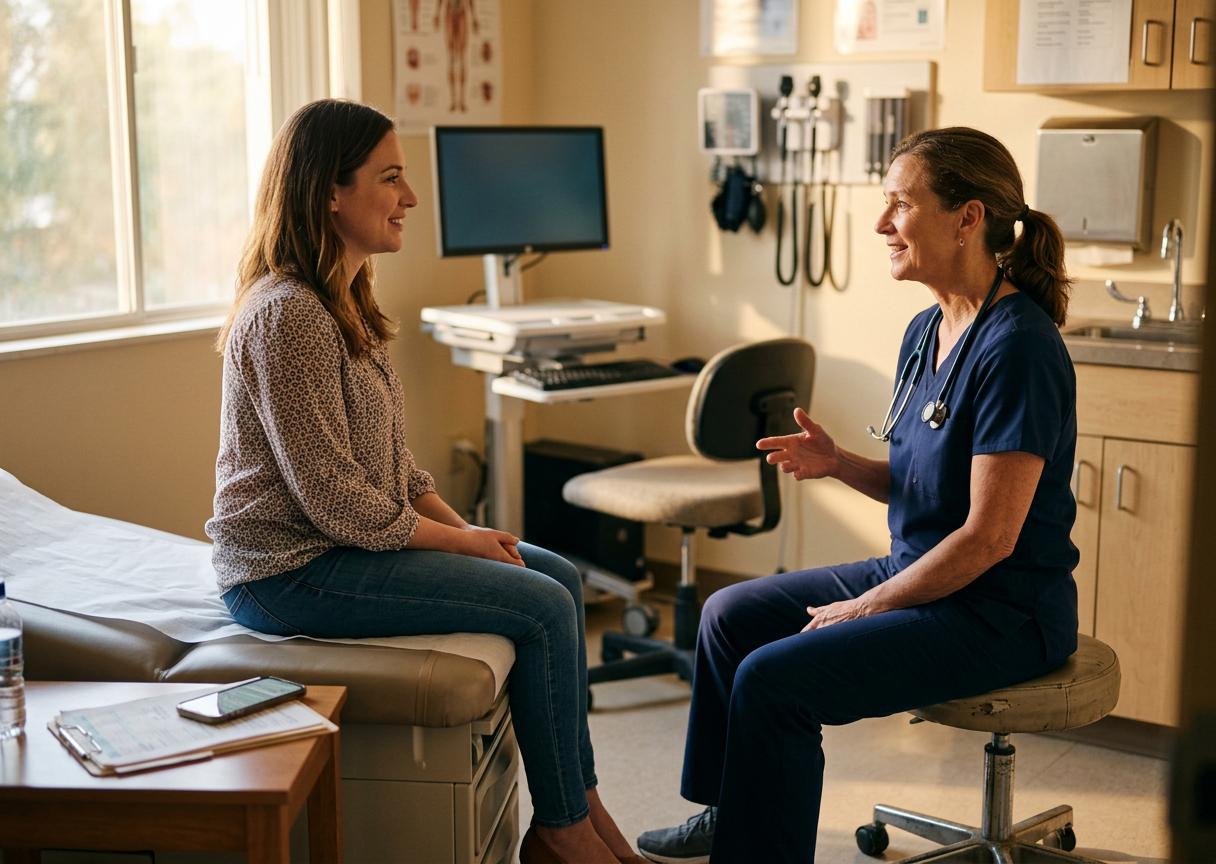
Essay one ended with a promise: this piece turns to the exam room, and to what AI means for the time doctors spend looking at a screen instead of a patient. That screen is worth picturing clearly. Walk into almost any exam room today and the doctor isn’t quite facing you — they’re turned partway toward a rolling workstation, typing while they talk, navigating drop-down menus and required fields in the middle of what’s supposed to be a conversation. It’s become such a familiar posture that most patients stopped noticing it years ago.
The Pajama Time Pandemic
That posture exists because of a workload most patients never see. A landmark 2016 AMA-funded study in the Annals of Internal Medicine found that for every hour a doctor spends face-to-face with a patient, they spend nearly two additional hours on electronic health record documentation and desk work — a ratio that’s held up as the reference point for physician burnout research ever since. A meaningful share of that spills past clinic hours entirely — clinicians finishing notes, entering orders, and clearing billing queues well into the evening, a pattern common enough that it has its own name in medicine: “pajama time.” It’s one of the most consistently documented contributors to physician burnout in the research literature.
The Unobtrusive Listener
The technology now spreading fastest into the exam room is built to attack that specific problem. Ambient AI scribes — led by platforms like Nuance DAX Copilot, Abridge, and ThinkAndor — run quietly on a phone, tablet, or wall-mounted microphone during the visit. The software separates speakers, filters out small talk, and pulls out what’s clinically relevant: symptoms, timelines, exam findings, treatment plans. Within minutes of the visit ending, it produces a structured draft note inside the patient’s chart — history, findings, assessment, plan — organized the way a specialty typically documents it. Critically, it stays a draft. The physician still has to review, edit, and sign it before it becomes part of the legal medical record.
Adoption has moved fast. As of June 2025, roughly 63% of U.S. hospitals running the Epic health record system had adopted at least one ambient AI documentation tool — a striking jump from an experimental pilot just two years earlier. Named health systems using these tools at scale include Mass General Brigham, Emory Healthcare, UChicago Medicine, and the Permanente Medical Group, among many others. Physician adoption is climbing too: a 2026 survey of more than 3,100 physicians found voice-based documentation use jumped from 20% to 29% in under a year.
Reclaiming Time — Or Just Moving It?
Here’s where the story gets more complicated than the adoption numbers suggest. Individual studies do show real gains: UChicago Medicine found clinicians using an ambient scribe spent 8.5% less total time in the EHR and 15% less time composing notes than matched colleagues who didn’t. Mass General Brigham reported a 21.2% drop in burnout prevalence within 84 days of adoption.
But a much larger 2026 study complicates the simpler version of this story. Published in JAMA in April 2026, it tracked 8,581 clinicians — some using ambient scribes, most not — across five major health systems over more than two years. Its central, and more sobering, finding: after-hours EHR time did not significantly decrease overall. The researchers’ explanation is that the time saved on writing notes tends to get spent on other things still inside the record — reviewing prior visits, answering inbox messages, processing lab results — rather than handed back as personal time. The burnout relief appears to be real, likely from feeling more present with a patient and less cognitively taxed during the visit itself. Getting evenings back is a different claim, and the strongest evidence so far doesn’t support it as a general rule.
Adoption is also uneven in ways worth naming honestly. Nonprofit hospitals have adopted these tools at more than double the rate of for-profit ones, and hospitals with stronger operating margins adopt faster than those without — the same kind of resource gap that shows up throughout U.S. healthcare technology generally.
The New Friction
Ambient listening is changing more than paperwork; it’s quietly changing how some doctors talk. Physicians report learning to narrate certain routine actions out loud specifically so the microphone captures them — saying “I’m listening to your lungs now, and they sound clear” during an exam that used to happen in silence. A quiet physical exam becomes a partly performed one.
The more serious risk is what happens when the software gets it wrong. Large language models can mishear medical terminology, attribute a family member’s history to the patient, or generate a plausible-sounding note that doesn’t match what actually happened. Multiple studies have now documented ambient AI systems producing notes describing physical examinations that were never performed — a striking example of exactly the risk the human-review step exists to catch. The technology here is still young, and the industry knows it — that mandatory sign-off step exists precisely because nobody in the field trusts these systems to work unsupervised yet, and the tools for catching errors before they reach the chart are actively improving. But when a physician trusts the draft enough to sign without reading it closely, that error becomes a permanent part of the medical record.
Privacy is a live and unresolved question rather than a settled one. Ambient scribes typically operate under HIPAA business associate agreements and encrypt data in transit, but how consent gets handled — a verbal notice, a posted sign, an opt-out — varies by state law and health system policy, and some patients report real discomfort with continuous recording during sensitive conversations about mental health, sexual health, or substance use.
There’s also an institutional temptation worth naming plainly. Time saved on documentation doesn’t automatically become rest. Some health systems may instead use the efficiency gains to increase the number of patients a doctor sees each day, rather than as time returned to the physician — which would erase the human benefit the tool was built to provide, even as the productivity numbers look identical on paper.
Before the Doctor Walks In
The friction starts even earlier than the exam room, at check-in. Where digital intake has replaced the paper clipboard, the first step was often simply putting the same questions onto a tablet — a real improvement, since it fixes the illegible handwriting and skipped fields that come with rushing through five pages by hand, but one that still carries the same rigidity as its paper predecessor, just moved onto a screen. The newer generation of intake tools is conversational instead: a patient checking in for knee pain gets asked a real follow-up — did it start suddenly or gradually, does it hurt more going up stairs — with the answers translated into structured clinical data and pushed into the chart before the doctor ever opens the door.
That same shift is starting to happen on the way out, too. The AI-generated note from the visit is increasingly the starting point for what comes next — draft patient instructions and follow-up summaries built from the same conversation, rather than a doctor reconstructing all of it from memory afterward. Early patient-experience research on this is encouraging on one specific point: patients generally don’t report a worse experience when a doctor uses an ambient scribe, and some studies suggest they notice a more attentive, less distracted physician across the table.
In Plain Terms
Here, in the exam room, artificial intelligence isn’t replacing a doctor’s judgment or performing the exam itself. Its job is removing some of the screen that’s crept between doctor and patient over the last two decades — and the evidence so far shows it succeeding at making visits feel more human, even where it hasn’t yet delivered the hours of personal time back that the marketing promises.
That’s a real paradox worth sitting with: a complex, cold technology, deployed to make a doctor’s attention feel warmer and less divided. It’s working, partially, unevenly, and in ways still being measured — which is a more honest place to land than either “solved” or “hype.”
The next essay in this series turns from the conversation to the data itself — how AI is beginning to read scans, flag lab results, and catch patterns a tired pair of human eyes might miss.
State of Play, as of August 2026
The one-hour-to-two-hours ratio of patient time to EHR time comes from a 2016 AMA-funded study in the Annals of Internal Medicine — a nearly decade-old figure that remains the standard reference point in physician burnout research. Epic hospital adoption figures (62.6%) come from a study published in the American Journal of Managed Care using June 2025 data. The UChicago Medicine documentation-time findings and the Mass General Brigham burnout study were both published in JAMA Network Open. The larger, five-system pajama-time study was published in JAMA in April 2026 as part of the Ambient Clinical Documentation Collaborative. Physician adoption survey data comes from Doximity’s 2026 physician survey. Figures on hallucinated exam findings draw on multiple independent reports rather than a single study; the field is moving quickly enough that more rigorous, larger-scale data is still emerging.