July 10, 2026
The Invisible Fuel: What Hydrogen Actually Is — and Isn’t
When most people hear “hydrogen vehicle,” they picture something like a gas-powered car — a tank of fuel, an engine that burns it, exhaust coming out the back. That picture is wrong in almost every detail.
A hydrogen vehicle is an electric vehicle. The motor is electric. The hydrogen isn’t burned — it’s used to generate electricity on the spot through a chemical reaction, and the only byproduct coming out the exhaust is water vapor. The hydrogen tank is doing the job a battery does in any other electric vehicle.
Understanding that one thing changes how hydrogen’s role in the energy transition makes sense. And it starts with a distinction that sounds simple but carries enormous consequences.
Hydrogen Is an Energy Carrier, Not an Energy Source
Oil is an energy source. Energy is locked inside it by nature, waiting to be released through combustion. Hydrogen is different. Pure hydrogen does not exist in nature — it is always chemically bonded to something else. Water is hydrogen chemically bonded to oxygen. Natural gas is hydrogen chemically bonded to carbon. In those bonded forms, that hydrogen is locked up and unusable. To get hydrogen you can actually store and use, you have to put energy in first to break those bonds and free it. Only pure hydrogen — separated out on its own — can serve as a storage vessel.
Think of it like a rechargeable battery. The battery doesn’t generate electricity — it stores electricity that came from somewhere else, then releases it when you need it. Hydrogen works the same way, at a much larger scale. You fill it with energy you’ve already generated, carry it to where you need it, and release that energy there.
This means hydrogen always costs energy to make. It is, in effect, a very large, very energy-dense storage vessel — one you fill using electricity, or in some cases heat from a nuclear or geothermal source, which can drive hydrogen production directly without first converting to electricity. And like any battery, some energy is lost in the filling and the emptying.
That loss matters, and we will come back to it.
What We Have Now — and What We Want
Nearly all of the world’s hydrogen today — roughly 95 percent — is made by reacting natural gas with high-temperature steam. The process works well. It is cheap and well understood. It also releases large amounts of carbon dioxide directly into the atmosphere, roughly 9 to 12 tons of CO2 for every ton of hydrogen produced. This is called grey hydrogen, and it is one of the most greenhouse gas-intensive industrial processes currently operating anywhere in the world.
There is a cleaner version, called blue hydrogen, that uses the same process but captures and stores the CO2 rather than releasing it. The technology exists, and it does reduce emissions significantly. The catch is upstream leakage. Natural gas pipelines leak methane — and methane is roughly 80 times more potent than CO2 as a greenhouse gas over a 20-year period. A widely cited study from Cornell and Stanford found that under realistic leakage scenarios, blue hydrogen’s true climate footprint can rival or even exceed simply burning natural gas directly. Blue hydrogen is transitional, not a destination.
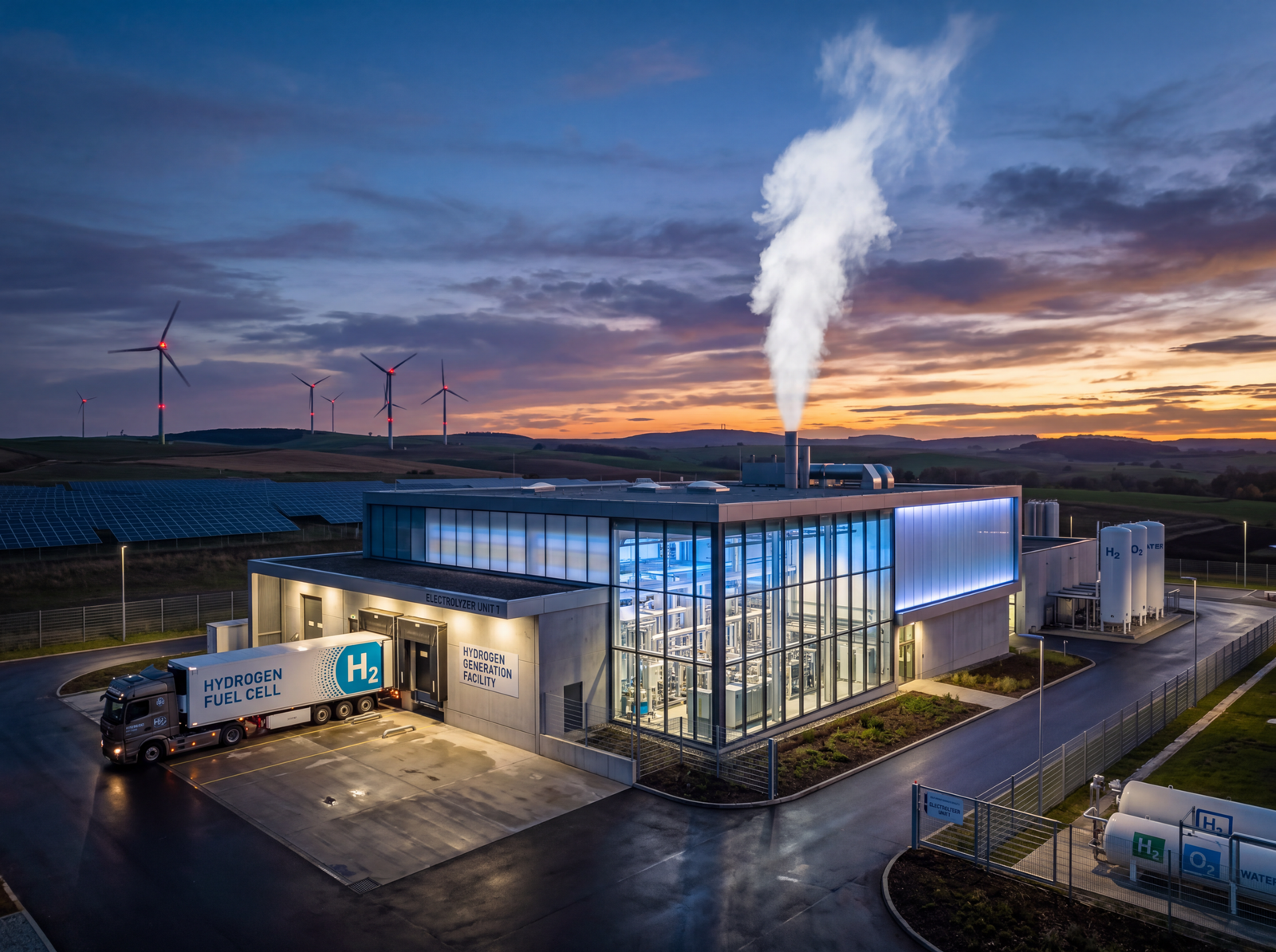
The destination is green hydrogen — made by running electricity through water to split it into hydrogen and oxygen. No carbon involved at any stage, and the only byproduct is oxygen. The catch is that this process requires substantial clean electricity — roughly the same amount a typical American home uses in two days to produce enough hydrogen to fill a single fuel cell vehicle tank. At current electricity prices, green hydrogen costs three to five times more than grey hydrogen to make. That gap is narrowing as renewable electricity gets cheaper, but it has not closed yet.
The Efficiency Problem
Here is the uncomfortable physics at the center of hydrogen’s future.
When you use electricity to make hydrogen, then compress and transport that hydrogen, then convert it back into electricity at the other end, you lose most of what you started with. The round-trip efficiency — electricity in, electricity out — is roughly 30 to 45 percent. That means for every 100 units of clean electricity you put into making hydrogen, you get back between 30 and 45 units of electricity at the end.
A lithium-ion battery, by comparison, achieves round-trip efficiency of 85 to 95 percent.
This is not a flaw that engineering will eventually eliminate. It is a consequence of the underlying chemistry. Which is why the question of where hydrogen makes sense is not “everywhere” but “specifically where.”
Where Hydrogen Actually Makes Sense
The efficiency loss does not matter in two important situations.
The first is when you have surplus clean electricity that would otherwise be wasted. Wind turbines on a gusty night generate electricity whether anyone needs it or not. Solar farms at noon in summer produce more than the grid can absorb. Converting that excess to hydrogen and storing it underground is far better than throwing it away — even at 30 to 45 percent efficiency, you are capturing energy that would otherwise be lost entirely. Hydrogen stored in underground salt caverns or depleted gas fields can hold that energy for weeks or months, smoothing out the seasonal gaps that batteries cannot bridge. Unlike batteries, which become prohibitively expensive for storing months of electricity, underground hydrogen storage can scale to seasonal quantities.
The second is in heavy industry, where electricity alone cannot do the job. Steel manufacturing is the clearest example. To turn iron ore into steel, you have to chemically strip the oxygen away from the iron — a process that requires hydrogen as the stripping agent, not as a fuel but as an active participant in the chemistry itself. A battery cannot do that job. The same kind of chemical role applies in fertilizer production, chemical refining, and certain aviation fuels. These sectors currently use grey hydrogen as their feedstock. Replacing that grey hydrogen with green hydrogen is one of the highest-impact decarbonization moves available, because it addresses emissions that electrification simply cannot reach.
Passenger cars are not where hydrogen makes its best case. A lithium battery is simply more efficient and already cheaper for that application. Long-haul trucking, cargo shipping, and aviation — where energy density matters more than round-trip efficiency, and where the weight of a large battery becomes a real liability — are where hydrogen’s advantages become meaningful.
The Storage and Transport Problem
Moving hydrogen from where it is made to where it is needed is harder than it sounds, and the reason comes down to a physical contradiction.
Hydrogen is extraordinarily energy-rich by weight — nearly three times the energy content of gasoline per kilogram, which is why it is attractive for vehicles and aircraft that need to carry as much energy as possible without adding mass. But by volume, hydrogen is the opposite problem: the same amount of energy takes up far more space than gasoline at normal pressures. To store meaningful quantities, you must either compress it to extremely high pressures, cool it to minus 253 degrees Celsius to force it into liquid form, or convert it into a carrier molecule like ammonia that is far easier to ship and can be converted back to hydrogen at the destination. Each approach adds cost and complexity.
There is also the problem of hydrogen embrittlement. Hydrogen is the smallest molecule in existence — so small that it physically migrates into the crystalline structure of standard steel pipelines, causing the metal to become brittle and crack under pressure over time. Repurposing existing natural gas infrastructure requires careful engineering and strict blending limits — typically no more than 15 to 20 percent hydrogen — to manage this problem. Moving pure hydrogen requires entirely new infrastructure built from materials specifically engineered to resist it.
The Policy Moment
The United States has had a significant financial incentive for clean hydrogen production — a tax credit worth up to $3 per kilogram, known as the 45V credit — that made green hydrogen projects financially viable. The One Big Beautiful Bill, signed into law on July 4, 2025, moved the construction start deadline for that credit forward by five years, from 2032 to the end of 2027. Projects that do not begin construction by December 31, 2027 will not qualify. The result has been a split: well-financed, shovel-ready projects are accelerating to hit the deadline, while more speculative projects have stalled.
China has responded differently, embedding hydrogen into its national industrial planning and focusing heavily on building low-cost electrolyzer manufacturing capacity for global export. Germany has declared hydrogen projects to be of “overriding public interest,” fast-tracking permitting in ways that would have taken years under standard regulatory processes.
State of Play, as of July 2026
Green hydrogen remains more expensive than grey. Electrolyzer costs have fallen roughly 60 percent since 2020, according to IEA data, and continue to fall. The IEA projects global electrolyzer manufacturing capacity will exceed 50 gigawatts per year by 2030. The hydrogen hubs funded under the U.S. Infrastructure Investment and Jobs Act are in various stages of development, though the DOE Inspector General has flagged incomplete risk assessments for the program. The 2027 construction deadline for the 45V credit is now the defining pressure point for U.S. green hydrogen development.
What This Means
Hydrogen will not replace oil the way electric vehicles might replace gasoline cars — directly, for the same applications, one for one. Its role is more specific and, in some ways, more important: storing clean energy across seasons and distances that batteries cannot manage, and decarbonizing industrial processes that electrification cannot touch.
Whether green hydrogen reaches its potential depends on how quickly the cost of clean electricity falls, how fast electrolyzer manufacturing scales, and whether the policy windows in each country stay open long enough for projects to get built. The physics are not going to change. The economics are.
For all its promise, hydrogen is still a way of storing energy created elsewhere. Fusion asks a completely different question: can we create an entirely new source of energy by reproducing the process that powers the stars? That is where this series turns next.