June 23, 2026
The mineral extraction costs documented in the previous essay are real — but they are not necessarily permanent features of the electric vehicle transition. Scientists and engineers working on next-generation battery chemistry are not simply trying to improve on lithium-ion. They are trying to replace its most problematic ingredients entirely.
Three technologies show the most credible near-term promise.
Sodium-Ion: The Immediate Alternative
Sodium-ion batteries work on the same basic principles as lithium-ion batteries, but substitute sodium — the primary element in common table salt — for lithium as the charge-carrying ion. The material profile changes dramatically as a result: sodium is harvested cheaply and abundantly from seawater or soda ash deposits, and the supporting chemistry uses iron and manganese rather than cobalt or nickel. The result is a battery requiring none of the three minerals at the center of the extraction crisis.
The environmental advantage is significant. Sodium is among the most abundant elements on Earth, distributed globally rather than concentrated in a handful of countries, and its extraction carries none of the water depletion, human rights, or deforestation consequences that define lithium, cobalt, and nickel mining.
The engineering tradeoff is straightforward: sodium ions are larger and heavier than lithium ions, which means sodium-ion batteries carry roughly 20 to 30 percent less energy per unit of weight. For a long-range highway vehicle, that gap matters. For affordable city cars and short-range urban delivery fleets — where most of the world’s driving actually happens — it does not. China’s CATL and BYD, the two largest battery manufacturers on Earth, are already mass-producing sodium-ion cells. Beyond vehicles, sodium-ion batteries are particularly well-suited for stationary grid storage, where weight is irrelevant and cost and safety are everything.
Iron-Air: The Grid’s Long-Duration Solution
Iron-air batteries operate on a principle that sounds almost too simple: reversible rusting. When the battery discharges, iron oxidizes — rusts — releasing electrons that flow as electricity. When the battery charges, that process reverses and the iron is restored. The entire cycle requires only three ingredients: iron, water, and oxygen from the surrounding air.
The material profile is as clean as battery chemistry gets. Iron is one of the most abundant, heavily recycled, and safely handled materials in industrial history. Iron-air batteries contain no heavy metals, pose no fire risk, and are almost entirely recyclable at the end of their working lives.
The limitation is equally clear: these batteries are heavy and they charge and discharge slowly — far too slowly for a vehicle that needs to accelerate in traffic. They are designed exclusively for stationary use. Form Energy, the leading commercial developer, is actively building multi-megawatt iron-air installations intended to store days of surplus solar and wind energy and release it gradually to stabilize the electrical grid. That function — long-duration grid storage — is one that lithium-ion batteries cannot economically perform at the scale the energy transition requires.
Solid-State: The Performance Leap
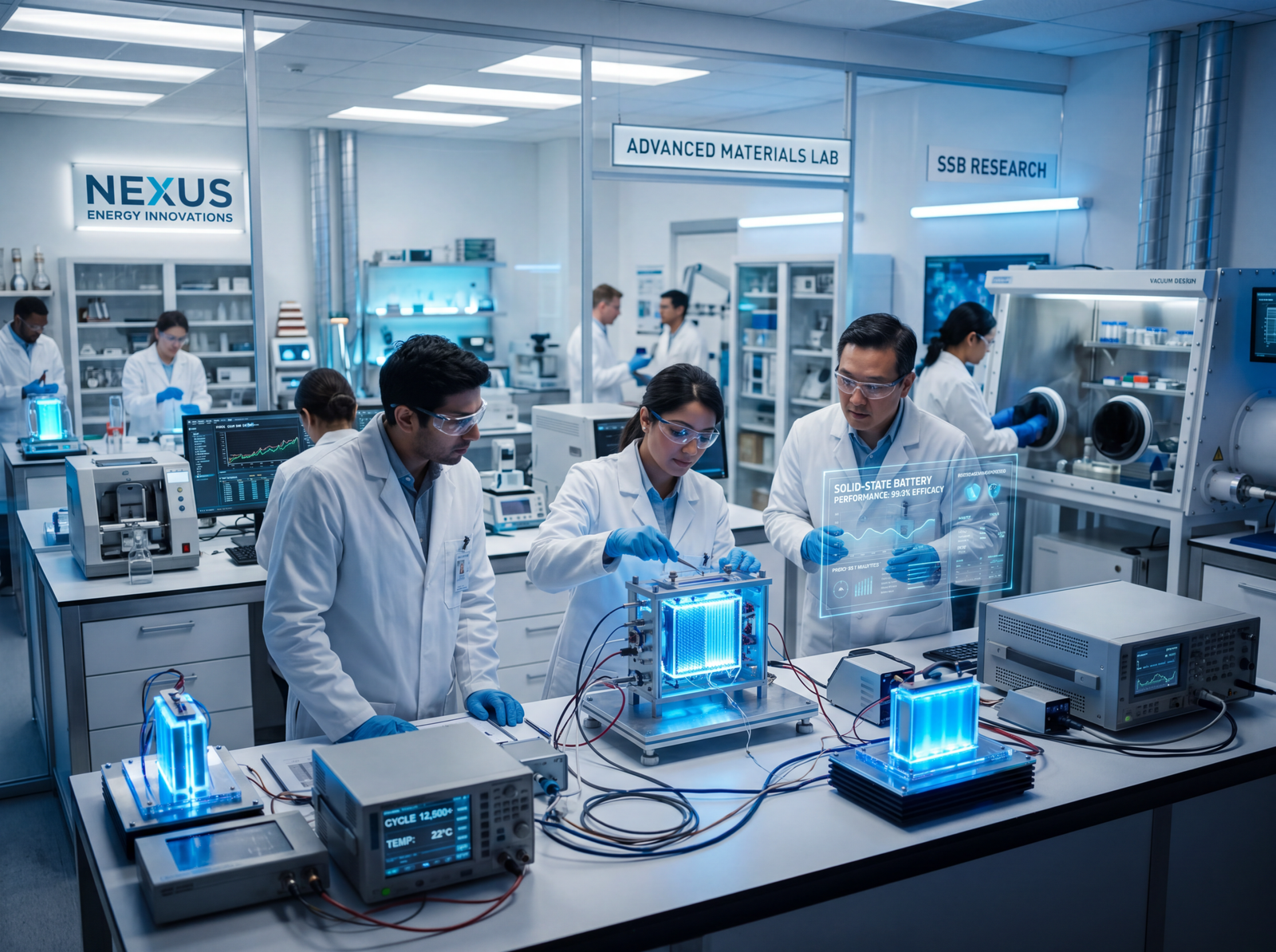
Traditional lithium-ion batteries use a liquid electrolyte to move ions between the anode and cathode. That liquid is chemically volatile, requires cobalt to stabilize, and is the primary reason lithium-ion batteries can catch fire if damaged or improperly charged. Solid-state batteries replace the liquid with a solid material — ceramics, glass, or specialized polymers — that is stable, non-flammable, and requires no cobalt to remain safe.
The performance gains are substantial. Solid-state batteries can use a pure lithium-metal or silicon anode, achieving roughly double the energy density of current EV batteries — enough for a projected driving range exceeding 600 miles on a single charge. Charging times that currently run thirty minutes to an hour at fast chargers could drop below ten minutes.
Toyota and Nissan are in advanced testing of solid-state cells for passenger vehicles, with Toyota having made the most public commitments to near-term production timelines. In the United States, QuantumScape — a solid-state battery startup backed by Volkswagen — has reached the prototype validation stage after years of development.
The primary obstacle is manufacturing. Producing the ultra-thin, defect-free solid layers required at automotive scale and competitive cost remains an engineering challenge no company has fully solved. The technology is real; making it reliably in volume is the remaining hurdle.
Where This Leaves Us
| Battery Technology | Eliminates Cobalt & Nickel | Eliminates Lithium | Best Application |
| Sodium-Ion | Yes | Yes | Affordable city EVs, grid storage |
| Iron-Air | Yes | Yes | Long-duration grid backup |
| Solid-State | Yes | Usually No | Long-range premium EVs |
No single technology solves every problem. What the three together suggest is a plausible path toward an energy storage ecosystem that is cleaner, less geopolitically concentrated, and less dependent on the handful of minerals that currently define — and constrain — the EV transition.
The Strait of Hormuz crisis did not create the argument for reducing oil dependency. It accelerated it. The technologies covered in this series are not speculative futures — they are active development programs with commercial deployments already underway. The transition will be uneven, expensive, and slower than its advocates hope. It will also, by almost every measure, be less damaging than the system it is replacing.