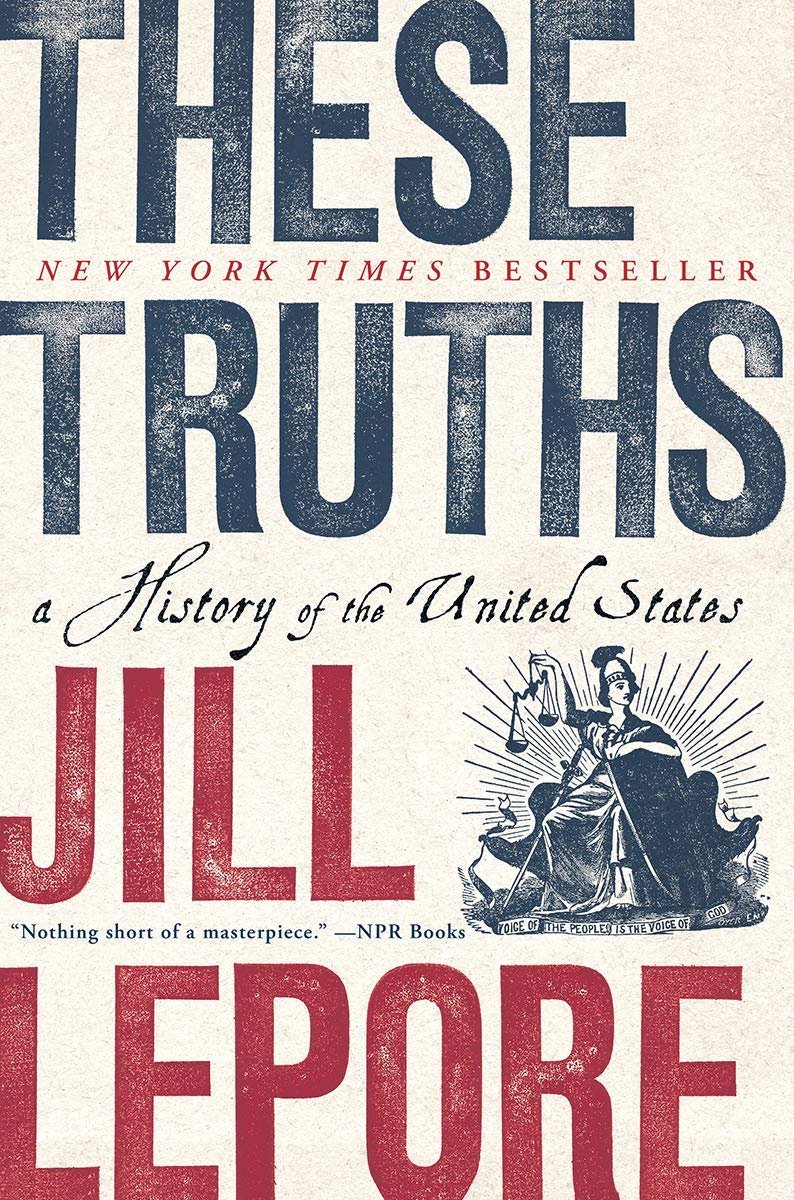
Jill Lepore
I finished this one on audio — 39 hours of it — and I’m still thinking about it weeks later.
Jill Lepore is a Harvard historian and a staff writer for The New Yorker, and she set out to do something that sounds impossible: write a single-volume history of the United States, from Columbus to Trump, in one coherent narrative. Not a textbook, not a polemic — a story, told with “the rigor of a scholar and the instincts of a writer.”
The title comes from the Declaration of Independence. Jefferson’s “these truths” — political equality, natural rights, the sovereignty of the people — form the book. Lepore’s driving question is simple and unsettling: Has the nation actually lived up to those founding promises? The answer she delivers, over nearly a thousand pages, is complicated, honest, and impossible to look away from.
What struck me most was her refusal to settle on easy answers. She doesn’t write heroes and villains — she writes people, all of them contradictory, all of them human. She doesn’t flinch from the ugliness — slavery, in particular, runs through this book like a wound that never fully heals — but she doesn’t wallow in cynicism either. Kirkus Reviews called it “a splendid rendering — filled with triumph, tragedy, and hope,” and that’s about right. Harvard Magazine described her as sitting somewhere between Herodotus and Hercule Poirot: sorting out not just what happened, but why and how.
One of the passages that struck me was her summary of the American condition: “A nation born in revolution will forever struggle against chaos. A nation founded on universal rights will wrestle against the forces of particularism. A nation that toppled a hierarchy of birth only to erect a hierarchy of wealth will never know tranquility.” It reads almost like a diagnosis. And it lands differently right now than it would have even a few years ago.
On audio, her prose really opens up. There’s a rhythm to her writing — vivid, occasionally lyrical, always clear — that carries you through centuries without ever feeling like a slog. She has a gift for the telling detail, the unexpected figure who illuminates an era, the sharp summary that makes you set down whatever you’re doing and just sit with it. I have since purchased a used paperback that I can mark up; it was impossible to retain it all from the audio version.
The New York Times Book Review called it “a sweeping, sobering account of the American past,” and I think “sobering” is exactly the right word. Not discouraging — sobering. The kind of book that makes you feel more clear-eyed about where we came from, which makes you a little more clear-eyed about where we are.
Why Read It
If you’ve ever wanted to understand America — not the mythology, not the political talking points, not the high school version, but the actual, complicated, contradictory story — this is the book. It’s long, but Lepore earns every page. Whether you read it or listen to it, you’ll come away with a sense of the whole arc in a way that’s hard to get anywhere else. And in a moment when so many people seem to be arguing from entirely different versions of history, there’s real value in sitting with someone who’s done the work of letting the evidence speak.
I’d also say this: it’s the rare history book that respects your intelligence without talking over your head or trying to sell you something. Lepore writes for readers, not for academics. That matters.
About the Author
Jill Lepore is the David Woods Kemper ’41 Professor of American History at Harvard University and a staff writer at The New Yorker. Goodreads She is one of the most decorated historians working today. Her early trilogy on American political history — The Name of War (1998), winner of the Bancroft Prize; New York Burning (2005), a Pulitzer Prize finalist; and Book of Ages (2013), a National Book Award finalist and Time magazine’s Best Nonfiction Book of the Year — established her as a major voice in American history. Harvard Magazine
The Secret History of Wonder Woman (2014) became a national bestseller and won the 2015 American History Book Prize, Harvard Magazine revealing the surprising feminist origins behind the iconic superhero. Her 2020 book, IF THEN: How the Simulmatics Corporation Invented the Future, was longlisted for the National Book Award. Harvard Magazine
These Truths (2018) became an international bestseller, named one of Time magazine’s top ten nonfiction books of the decade. Her most recent book, We the People: A History of the U.S. Constitution, a New York Times bestseller, was published in 2025, and a revised edition of These Truths is due in 2026. Goodreads