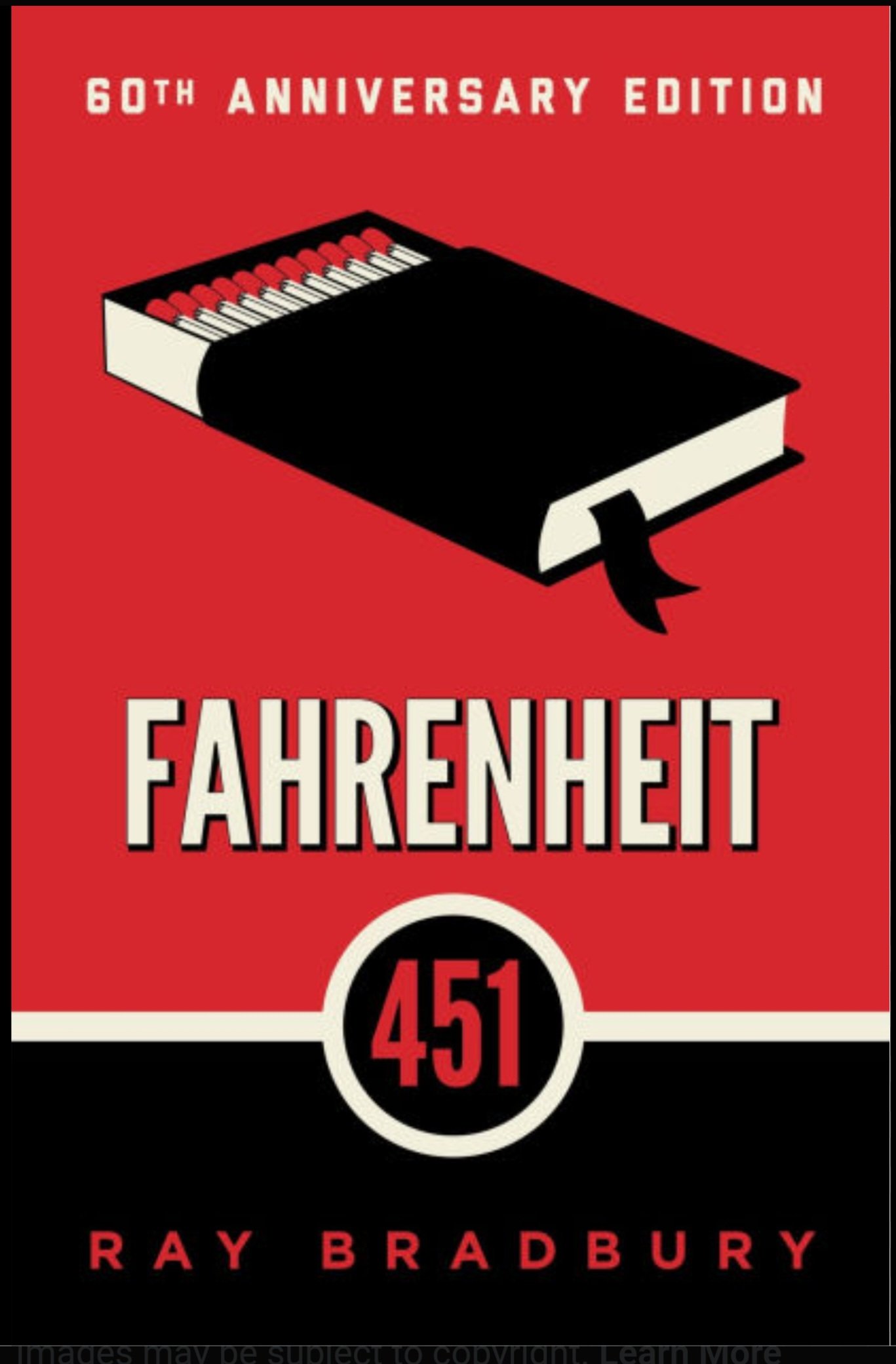
- My son recommended this book to me. It invoked many emotions as I read it. I found it appalling that censorship and the banning of literature and knowledge has happened time and again, throughout history. Even though this novel was written in the 1950’s, it is crazy how much of this is relevant to the shift of world today. I feel fortunate that we are free to read, learn, teach, and have the ability to think for ourselves!
A Review by Rich, (Research by AI Claude)
There is a reason this slender novel — barely 158 pages — has never gone out of print. Ray Bradbury wrote it in nine days on a rented typewriter in the basement of UCLA’s Powell Library, and the speed shows: it burns from the first sentence. “It was a pleasure to burn.” You are inside Guy Montag’s twisted joy before you’ve had time to object.
The premise is deceptively simple. In a future America, firemen don’t put out fires — they start them. Books are contraband. Montag is a loyal fireman until a teenage neighbor named Clarisse asks him a question no one asks anymore: “Are you happy?” That question, so innocent it feels like an accusation, cracks Montag open and drives the entire arc of the novel.
What Bradbury understood, with an almost prophetic clarity, is that censorship doesn’t usually begin with a government decree. It begins with comfort. His citizens didn’t lose their books to a tyrant — they surrendered them voluntarily to the narcotic glow of wall-sized television screens and the empty chatter of “seashell” earbuds. Sound familiar? Bradbury was ahead of his time in depicting the harm technology would cause — protagonist Montag’s wife Mildred, glued to her earplug radio and massive television screens, is alienated, isolated, easily manipulated, and apathetic. The Literary Lifestyle® He wrote that character in 1953, decades before the smartphone.
The novel’s greatest insight — and Bradbury said this himself — is encapsulated in one of its most quoted lines: “You don’t have to burn books to destroy a culture. Just get people to stop reading them.” The firemen are almost beside the point. The real fire was already burning in people’s indifference.
The prose is lyrical, urgent, and occasionally overwhelming — this is not a dry polemic but a fever dream. Captain Beatty, Montag’s boss and the novel’s most chilling character, is a man who has read everything and uses that knowledge to defend burning it all. He is the book’s most disturbing creation: the intellectual who becomes the instrument of anti-intellectualism. The closing section, in which Montag joins a community of “book people” who have memorized entire texts to carry them forward, is quietly beautiful — an act of faith that ideas, once truly alive in a human mind, cannot be extinguished.
Rating: Essential. Not just a great novel — a mirror.
A Brief Timeline of Book Burning & Banning in America
The impulse is older than the republic itself.
1651 — The First, Boston: The first book burning in what would become the United States occurred in Boston when William Pynchon published a pamphlet criticizing the Puritans in power; colonists denounced him as a heretic and burned his work — the first such incident in North America. Wikipedia
Early 1800s — The Slavery Divide: In the first half of the 19th century, Southern slaveholders burned and banned anti-slavery materials; when Harriet Beecher Stowe published Uncle Tom’s Cabin in 1851, it became an instant bestseller — and Southern communities burned copies and banned it from bookshelves. In Maryland, a free Black minister was sentenced to ten years in prison simply for owning a copy. National Geographic
1873 — The Comstock Act: The first federal censorship law, targeting “obscene” texts and anything related to birth control or sexuality. It was weaponized against literature for decades.
World War I — Anti-German Purges: Following America’s entry into WWI, anti-German sentiment turned into vigilante action — in North Platte, Nebraska, for example, several hundred German-language textbooks were taken from a high school and burned on a vacant lot while a crowd sang. Local newspapers praised the act. LOC
1940s–50s — The McCarthy Era: During the Cold War’s early years, the U.S. saw a fresh wave of book burnings. The State Department, under Secretary Dulles and with President Eisenhower’s tacit approval, ordered U.S. libraries abroad to remove books by “Communists, fellow travelers, et cetera.” In 1953 — the same year Bradbury published Fahrenheit 451 — Eisenhower stood at a Dartmouth commencement and urged students, “Don’t join the book burners,” even as his own administration was doing exactly that overseas. Time Bradbury later confirmed he wrote the novel in direct response to this atmosphere, furious at McCarthy and the House Un-American Activities Committee.
2000s–2010s — Harry Potter & the Culture Wars: From 2000 to 2009, the Harry Potter series topped the American Library Association’s list of most frequently challenged books, with complainants objecting to depictions of witchcraft and magic. Freedom to Read
2021–Present — The Current Wave: Book burnings have re-emerged in recent years — a Nashville pastor held a bonfire to burn books he deemed ungodly; a Tennessee library employee was fired for burning books by Trump and Ann Coulter; Texas school districts began removing titles deemed “inappropriate.” Georgetown University In the academic year 2023–2024, nationwide school book bans topped 10,000 — tripling the number from the previous year. Hi’s Eye According to PEN America, 1,477 individual books were banned in just the first half of the 2022–23 school year, with roughly 41% involving LGBTQ+ themes and 40% featuring prominent characters of color. The Harvard Crimson
In a remarkable irony, Fahrenheit 451 itself was placed on restricted access lists in Colorado, alongside 1984, Brave New World, and Anne Frank: The Diary of a Young Girl — until a federal judge ordered the district to restore all 129 titles in March 2025. Marshall Libraries
I asked AI Claude to provide the above “timeline of “book burning/book banning” episodes in the USA. I then made the statement; I feel we are in one now, what are your thoughts. To read the response, click here to jump to the LIVING WITH AI Series.
- Ray Bradbury
- Fiction
- Renee
-
I read Fahrenheit 451 at Renee’s recommendation; actually I started to read it and I came across a review where there was a strong recommendation to list to Tim Robbins narrate it, I am so glad I did, WOW!
With some AI help I have written a review of the book, then I asked the AI Clause for it thoughts on a couple questions pertaining to history and today which I liked back to the Series on, LIVING WITH AI.
Thank you Renee! I will take a look at it.
❤️