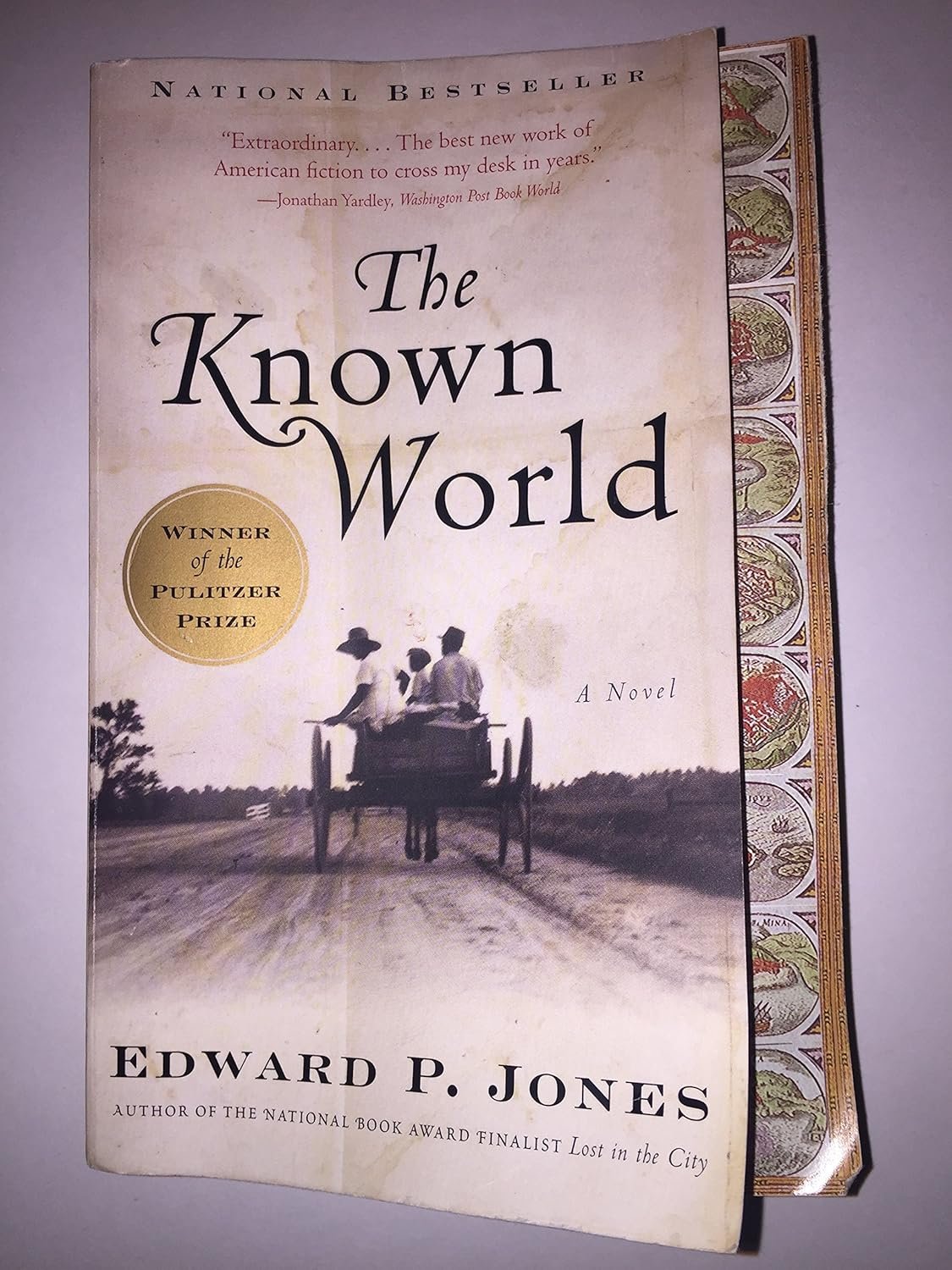
I first heard of The Known World in an Ezra Klein interview with Jonathan Blitzer, a staff writer at The New Yorker. The show always ends with the guest being asked for three book recommendations with an explanation of why. I will often research the recommendation if their reason to read perks my interest, and Jonathan’s did on all three recommendations.
Below is what my research turned up and why it is now in line, maybe not next but soon, following, These truths, by Jill Lepore, which I am halfway through; what an education!
This Pulitzer Prize-winning novel is a profound and complex exploration of a lesser-known chapter of American history. It is often described as “essential reading” for its ability to weave a vast, multi-generational tapestry with clinical precision and deep empathy.
You should read The Known World because it challenges almost everything we think we know about the “social architecture” of the antebellum South. Edward P. Jones does not write a simple story of good vs. evil; instead, he explores the moral rot of slavery and how it corrupted every human connection it touched—regardless of race. If you appreciate literary puzzles and books that treat history as a living, breathing, and often contradictory thing, this masterpiece will stay with you for years.
- Edward P. Jones
- Historical Fiction
- Rich
-
The story is centered in the fictional Manchester County, Virginia, and begins with the death of Henry Townsend. Henry is a black man who, having been born into slavery and later bought his own freedom, has become a powerful farmer and—most controversially—a black slaveholder himself.
The novel does not follow a straight line; it moves backward and forward in time, tracing the lives of Henry’s parents, his wife Caldonia, his white mentor William Robbins, and the many people Henry enslaved. As the “known world” of the Townsend plantation begins to unravel after Henry’s death, Jones reveals a vast web of interconnected lives, showing how the institution of slavery created a labyrinth of tragedy that no one, whether free or bond, could truly escape.⭐ Reviews
The New York Times Book Review:
“A masterpiece that deserves a place on the shelf next to Beloved and The Confessions of Nat Turner… Jones has written a book that is epic in its reach and terrifying in its intimacy.”
The Washington Post:
“Edward P. Jones has created a world so complete and so convincingly detailed that you feel you have lived in it. It is a stunning achievement of the imagination and a profound meditation on the nature of freedom.”🎙️ Audible Note
The audiobook is narrated by Kevin Free, and it is a stellar production. Because the book has a very large “cast” of characters and moves through different time periods, a narrator’s clarity is vital. Free provides a calm, dignified, and measured performance that mirrors the book’s journalistic yet lyrical tone. His ability to give distinct, subtle voices to the diverse residents of Manchester County makes the complex narrative much easier to follow during a long listen.